

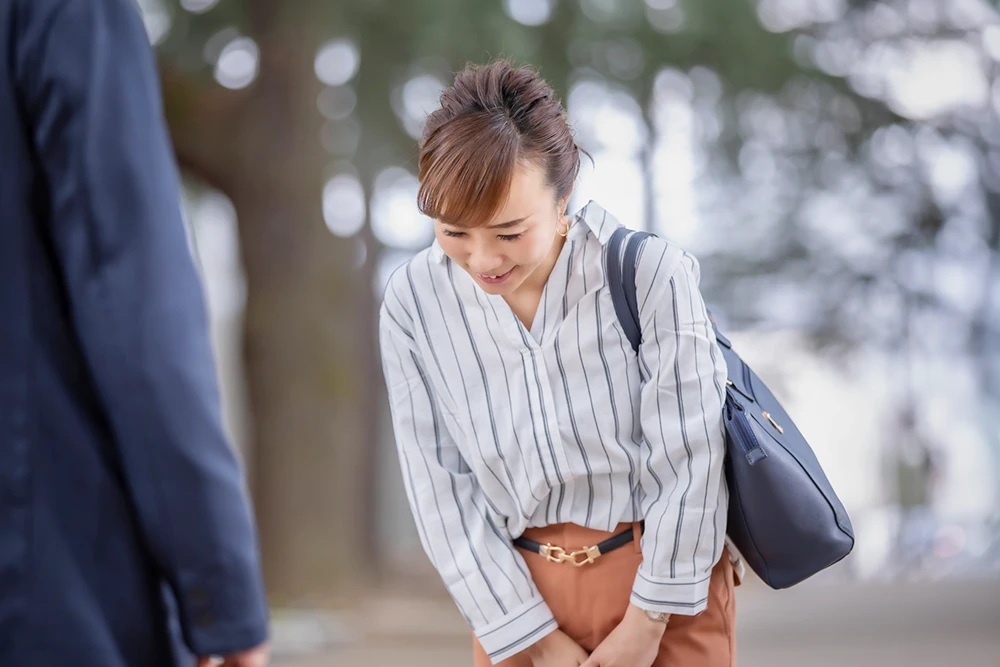
The Japanese Bow: Understanding a Signature Japanese Gesture
When visiting Japan, many foreign visitors are struck by how often Japanese people bow. Sometimes, they even bow while talking on the phone, even though the person on the other end cannot see them. This may leave many visitors wondering: “Why do Japanese people bow so much?” “Do they change the angle of the bow every time?” “Does each bow really have a different meaning?”
The truth is that bowing is more than just a physical gesture. It is an integral part of communication, reflecting the Japanese way of thinking about relationships and showing consideration for others.
This article takes an easy-to-understand look at the different types of bows, what each one means, when they are used, and the role bowing plays in Japanese culture.
An Overview of Bowing in Japan
Bowing is a gesture used to show respect, gratitude, and courtesy by leaning the head and upper body forward. In Japan, people bow in a variety of situations, including:
・ Greetings: “Good morning” and “Hello”
・ Expressing gratitude: “Thank you”
・ Apologizing: “I’m sorry” and “I sincerely apologize”
・ Making a request: “Thank you in advance” or “I appreciate your help”
・ Saying goodbye: “Excuse me” when leaving or “Goodbye”
・ Showing respect: To show respect for others
In other words, bowing in Japan carries a range of meanings, including gratitude, apology, respect, requests, and greetings. In Western countries, a handshake or eye contact may be an important part of a greeting. In Japan, on the other hand, lowering the head toward another person is a way of expressing respect and humility.
Furthermore, Japanese people often place great importance on nonverbal communication, such as facial expressions, posture, and tone of voice. Bowing can be considered one form of this kind of communication.
Three Different Types of Bows
In fact, there are three types of bowing commonly used in Japan. In particular, in business settings and customer service industries, they are called 会釈: eshaku, 敬礼: keirei, and 最敬礼: saikeirei, depending on the depth of the bow.
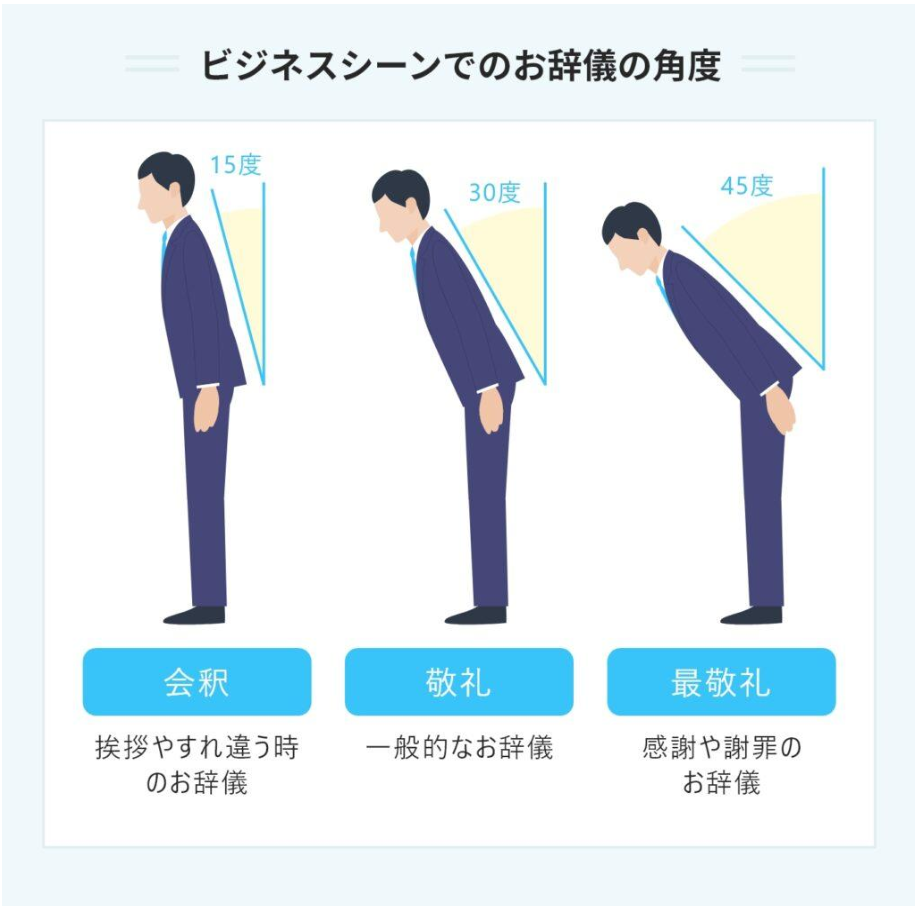
Eshaku — 15° Bow
Eshaku is the most casual form of bowing. It is used when passing someone, for a casual greeting among coworkers, or to express a small gesture of appreciation.
Examples:
・ Ohayō gozaimasu — “Good morning.”
・ Otsukaresama desu — “Thank you for your hard work.”
It is a relatively simple bow in which the head and upper body are lowered slightly.
Keirei — 30° Bow
Keirei is a polite and commonly used form of bowing. It is used when greeting customers, meeting someone for the first time, or expressing gratitude.
It is often accompanied by phrases such as Arigatō gozaimasu (“Thank you”) and Yoroshiku onegai itashimasu (“Thank you in advance” / “I look forward to working with you”). It is considered a fundamental part of business etiquette in Japan.
Saikeirei — 45° Bow
Saikeirei is the most formal and deepest form of bowing in Japan. It is used to show respect to important customers, offer a serious apology, or in formal settings. By bowing deeply, people can convey strong feelings of gratitude, apology, and respect. It is often accompanied by phrases such as Taihen mōshiwake gozaimasen (“I am deeply sorry”) and Makoto ni arigatō gozaimasu (“Thank you very much”), which express particularly strong feelings.
Bows approaching 90 degrees may sometimes be seen on television during apology press conferences. However, these are different from saikeirei and represent an especially intense expression of apology and remorse. Such an extremely deep bow is rarely seen in everyday life.
Note: The angles of approximately 15, 30, and 45 degrees are only general guidelines. In practice, the depth of a bow varies depending on the relationship between the people involved, the situation, and the industry.
Different Bows for Different Situations
Japanese people often choose an appropriate depth of bow depending on who they are interacting with and the situation. For example, they may give a light bow (eshaku) when meeting a friend, bow more politely when greeting a teacher or supervisor, and bow more deeply when welcoming a customer. When expressing deep gratitude, they may bow even more deeply, sometimes using saikeirei. In this way, the depth of a bow can be adjusted according to the situation.
That said, the way people bow in real life can vary not only depending on their relationship with the other person and the situation, but also on the industry. The depth of the bow is not everything.
For instance, when serving the same type of customer, convenience store workers may give a light bow while saying “Thank you,” whereas receptionists at five-star hotels and high-end department stores may bow more deeply and slowly to convey a sense of welcoming someone as a valued customer.
What matters, in fact, is not just the angle of the bow. Elements such as timing, speed, posture, eye contact, and facial expressions are equally important. A quick, casual bow may not give a polite impression. Instead, looking at the other person first, keeping the back straight, and slowly lowering the head can create a more respectful impression.
Bowing as an Everyday Japanese Courtesy
In Japan, bowing isn’t just a form of etiquette for adults. Children in kindergarten and elementary school also have many opportunities to bow as part of their everyday school life.
For example, they may bow when saying:
・ おはようございます: Ohayō gozaimasu — “Good morning.”
・ ありがとうございます: Arigatō gozaimashita — “Thank you.”
・ よろしくお願いします: Yoroshiku onegai shimasu — “Thank you in advance.”
・ さようなら: Sayonara — “Goodbye.”
Many schools also have students bow to their teacher together at the beginning and end of class. In this way, children in Japan have opportunities to learn about showing respect for others, expressing gratitude, and valuing good manners through bowing.
To someone from another country, this may seem like a mere formality. However, for people in Japan, bowing is one of the natural ways of expressing feelings alongside words.
So, is it really true that Japanese people bow even when talking on the phone?
The answer is yes. Some people may wonder why Japanese people bow while talking on the phone, even though they cannot see the other person’s face. This is because bowing is not simply a gesture meant to be seen by others. It can also be a deeply ingrained habit that has become part of everyday behavior over time.
The desire to speak politely, express gratitude, or convey a sense of apology can sometimes unconsciously appear through physical movements. As a result, Japanese people themselves may find that they have bowed without even realizing it.
So, is it rude if a foreign visitor does not bow?
The truth is, not necessarily. Japanese people understand that bowing is a unique part of their culture and that people from other countries have their own ways of greeting others. That said, for those who live in Japan or work with Japanese people, knowing how to give a light bow can sometimes leave a positive impression.
Here are a few simple ways to express these feelings:
・ Give a slight bow.
・ Say Arigatō gozaimasu (“Thank you”).
・ Say Yoroshiku onegai shimasu (“Thank you in advance” / “I look forward to working with you”).
There is no need to memorize the exact depth of each type of bow. What matters most is expressing the feeling that the other person is valued.
By taking a closer look at bowing, it becomes clear how much Japanese people value harmony and relationships with others. By creating a brief pause while bowing deeply, people can express gratitude, reflection, respect, and humility.
In Japanese culture, people often place greater value on maintaining smooth relationships with others than on strongly asserting their own feelings. Bowing is one of the gestures that symbolizes this characteristic of Japanese communication.
Take Your Japanese Further at TCJ
Learners tend to focus on grammar and vocabulary when studying Japanese. However, to acquire natural communication skills, understanding Japanese culture and etiquette is equally important. Although bowing is not a form of language itself, it can offer a valuable insight into the way Japanese people think and how they build relationships with others.
At TCJ, students are encouraged to learn the cultural knowledge and communication skills that are essential for living and working in Japan, alongside the language itself. Giving a slight bow when saying Arigatō gozaimasu, or bowing while saying Yoroshiku onegai shimasu, are small gestures that can sometimes make communication with native speakers smoother.
Why not join us at TCJ, where students can learn not only the Japanese language, but also Japanese culture and communication?

SHARE ON



- Japanese Greetings
- Japanese Phrases
- Online Lesson
- JLPT
- Business & Daily Life Japanese Program
- ビジネス日本語
- Interview
- 日本語上級者
- Japanese tips
- 日本語学習
- Kanji
- Want to Learn Japanese
- Private Lesson
- Japanese for Expats
- International Student Visa Program
- Job Hunting in Japan
- Japanese Language School
- Email Phrases
- Business Japanese
- Keigo
- Japanese For Executives
- Japanese Manners
- Learn Japanese
- Japan Trivia
- Basic Japanese
- Japanese Culture
- Japanese Beginner
- Japanese Advanced
師走: Shiwasu, 神無月: Kannazuki, and More: The Traditional Japanese Names for the Months
Top 5 Japanese Schools in Tokyo Recommended for Foreign Residents