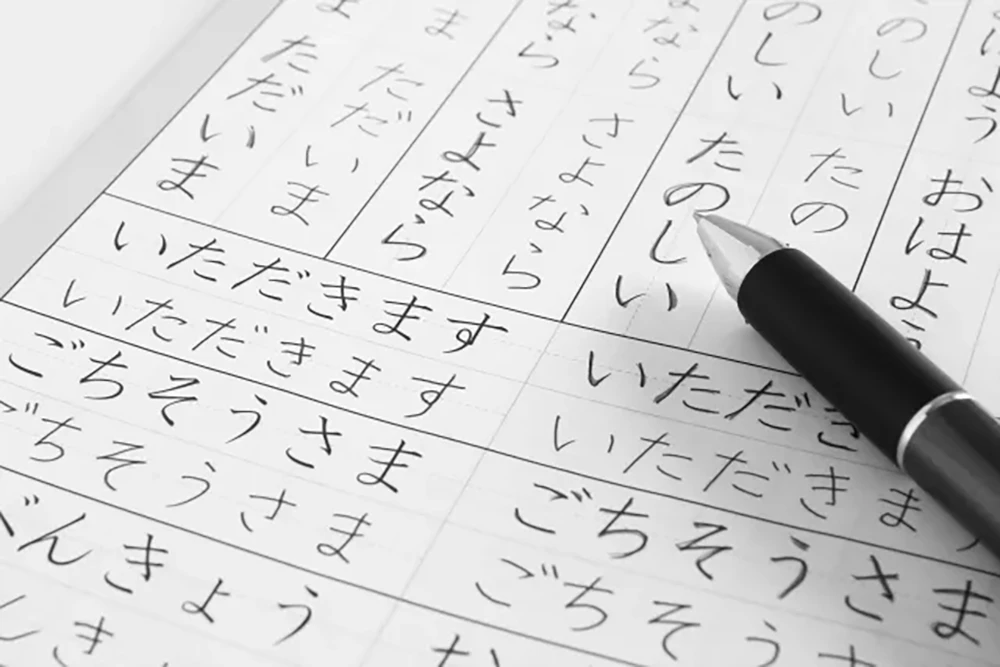
A Guide to Japanese Pronunciation: Practice Using Example Sentences

Many of you may have the goal of becoming fluent in Japanese. Today, we will introduce several pronunciation techniques that can help you speak Japanese more clearly, like a native.
Understanding the Rhythm of Japanese
The easiest and most effective way to sound natural when speaking Japanese is to master its rhythm.
In Japanese, each sound is pronounced with the same length. Like a ticking clock or a metronome, the rhythm is steady and even. For example, “a” (あ) takes one beat, while “inu” (いぬ) takes two, with each sound lasting exactly one beat.
Here are some more examples:

The word “a-i-sa-tsu” (あ・い・さ・つ) has four sounds of equal length, so it takes four beats. Let’s look at three ways to practice speaking with an even rhythm.
- Clap your hands to a steady beat while pronouncing the sounds.
- Count beats by folding your fingers.
- Use a metronome app or website, and set it to a 4/4 rhythm.
The basic rule for Japanese pronunciation is to pronounce each sound for one beat. However, there are some exceptions, such as long vowels and sounds that are silent but still count as one beat in Japanese. Let’s take a look at the pronunciation of these irregular sounds.
Pronunciation of Long Vowels: ー
Try saying おはようございます (Ohayo gozaimasu) out loud while counting each sound. How many sounds did you get?
Eight? Or nine?
The correct answer is nine. If you got eight, you may have skipped the う (u) at the end of おはよう (Ohayo).

In this example, the “う” in おはよう is a long vowel sound.
In hiragana, long vowels are written using the regular vowels あ・い・う・え・お (a・i・u・e・o). In katakana, they are represented with a -.
Cake (ケーキ, けえき, ke e ki) has three sounds, while Coffee (コーヒー, こおひい, ko o hi i) has four sounds.
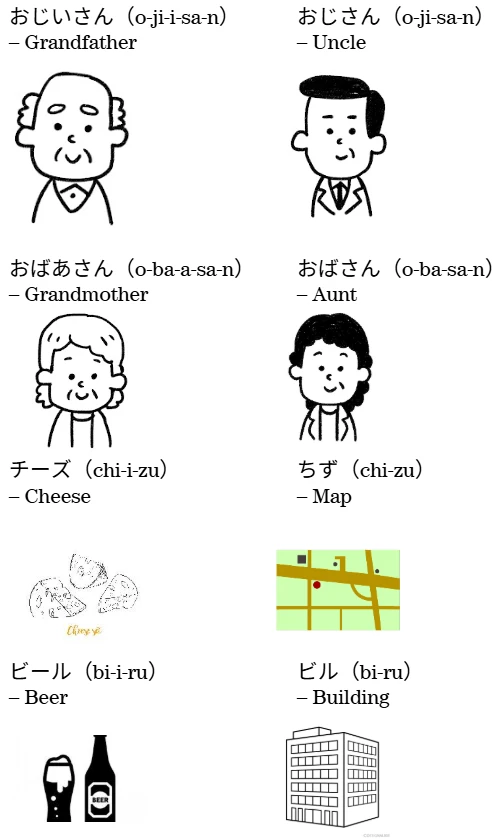
Here are some examples of words that change meaning depending on whether they have long vowels or not:
Geminate Consonants: っ / ッ
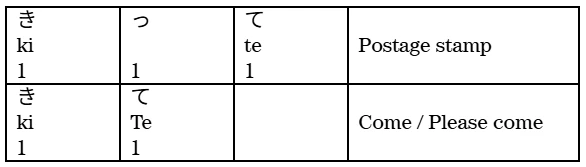
The small ”っ” or ”ッ” (tsu) represents a sound that is not pronounced out loud.
For example: きって (ki-tte) / きて (ki-te).
In kitte, you make a brief pause after ki before pronouncing te.
Accurately pronouncing words that include the small ”っ” or ”ッ” (tsu) will make your Japanese sound more natural. It will also help listeners understand you more easily.

Let’s practice!
Please pay attention to long vowels and the small “っ/ッ” (tsu) when you pronounce the words.
1 カップ(ka-_-pu)– Cup
2 ロケット(ro-ke-_-to)– Rocket
3 インターネット(i-n-ta-a-ne-_-to)– Internet
4 バスケットボール(ba-su-ke-_-to-bo-o-ru)– Basketball
The “ん” Also Counts as One Beat
The “ん” (n) at the end of a hiragana word also counts as one beat.
Try counting the beats in konnichiwa and konbanwa. Both have five beats, but if you don’t recognize the “ん” (n), you might only count four.

Practice being mindful that “ん” counts as a beat.
1 パン(pa-n)– Bread
2 にほん(ni-ho-n)– Japan
3 おんがく(o-n-ga-ku)– Music
4 せんせい(se-n-se-i)– Teacher
The Pronunciation of “ゃ”, “ゅ”, and “ょ”
There are sounds formed when a small ゃ (ya), ゅ (yu), or ょ (yo) is added to き (ki), し (shi), ち (chi), に (ni), ひ (hi), み (mi), or り (ri). These sounds count as one beat. ひゃく is pronounced with 2 beats: hya-ku, while ひやく is pronounced with 3 beats: hi-ya-ku.

Where do you think the difference is between びょういん (byo-u-i-n) and びよういん (bi-yo-u-i-n)?

Let’s practice some more!
1 きゃべつ(kya-be-tsu)と きゅうり(kyu-u-ri)
– Cabbage and cucumber
2 しんじゅくしょうがっこう(shi-n-ju-ku-sho-ga-_-ko-u)
– Shinjuku Elementary School
3 そうりがしょうりした(so-u-ri-ga-sho-u-ri-shi-ta)
– The Prime Minister won.
4 おきゃくさんがりょうりをちゅうもんした
(O-kya-ku-sa-n-ga-ryo-ri-wo-chu-u-mo-n-shi-ta)
– The customer ordered the food.
Practice Japanese Pronunciation
We have looked at the beats of sounds and rhythm here. Next, we will focus on how to produce the sounds of words.
Some learners of Japanese may have heard these sounds but still find it difficult to distinguish between them.
For example:
1 Learners may not be able to distinguish between sounds with and without dakuten (〝), such as が (ga) vs か (ka), or だ (da) vs た (ta).
2 They may not recognize う (u) or ん (n).
3 た・ち・つ・て・と (ta, chi, tsu, te, to) may be pronounced like さ・し・す・せ・そ (sa, shi, su, se, so).
4 た・つ (ta, tsu) may be pronounced as ちゃ・ちょ (cha, cho).
5 They may say あります (arimasu) instead of ありません (arimasen).
6 じゃ・じゅ・じょ (ja, ju, jo) may be pronounced as ざ・ず・ぞ (za, zu, zo).
This is likely because these sounds do not exist in the language you use in your daily life.
Now, what kind of practice works best?
1 Ask someone who shares your native language and is proficient in Japanese pronunciation to teach you. You will likely see results relatively quickly, so if there is someone around you with good Japanese pronunciation, we encourage you to ask for their help.
2 Engage in both input (listening and reading) and output (speaking) repeatedly.
3 Listen to short passages repeatedly and mimic them, or practice tongue twisters regularly.
Let’s practice Japanese tongue twisters and short phrases:
1 科学者 (かがくしゃ) / 学者 (がくしゃ) / 学習者 (がくしゅうしゃ)
(kagakusha / gakusha / gakushuusha) – scientist / scholar / learner
2 月が好きな鈴木さん (つきがすきなすずきさん)
(Tsuki ga suki na Suzuki san) – Mr./Ms. Suzuki, who likes the moon
3 しかのこのこのここしたんたん
(Shika no ko no ko no ko koshi tan tan) – A playful tongue twister involving baby deer
4 生麦 / 生米 / 生卵 (なまむぎ / なまごめ / なまたまご)
(namamugi / namagome / namatamago) – raw wheat / raw rice / raw egg
5 郵便局へ行って切手買って来て (ゆうびんきょくへ いって きって かって きて)
(Yuubinkyoku e itte kitte katte kite) – Go to the post office and buy some stamps
6 手術中の社長 (しゅじゅつちゅうのしゃちょう)
(Shujutsu-chuu no shachou) – The president during surgery
7 正月に彼女と神社へ行く (しょうがつ に かのじょ と じんじゃ へ いく)
(Shougatsu ni kanojo to jinja e iku) – I go to the shrine with my girlfriend at New Year
8 私が作った料理です。どうぞ。 (わたしがつくったりょうりです。どうぞ。)
(Watashi ga tsukutta ryouri desu. Douzo) – This is the food I made. Please enjoy.
9 ありがとうございます。ひとつ、いただきます。
(Arigatou gozaimasu. Hitotsu itadakimasu) – Thank you. I’ll have one (bite), please.
Take Your Japanese Proficiency to the Next Level at TCJ
Improving your pronunciation requires repeated practice in listening, reading, and speaking aloud. You might begin by listening to and mimicking short passages or practicing casual conversations from textbooks. As your confidence grows, you can progress to expressing your own thoughts and opinions or engaging in conversations with classmates.
At TCJ, our classes go beyond merely listening to the instructor. We encourage you to participate actively and work toward becoming someone who can communicate effectively and confidently in Japanese.
[References]
Japanese Pronunciation Laboratory.
https://www.jp-lab.com/
Japanese Example Sentences.
https://j-nihongo.com/
Tokyo University of Foreign Studies. Language Module: Japanese Pronunciation.
https://www.coelang.tufs.ac.jp/mt/ja/pmod/practical/
Tsutaeru Hatsuon.
https://www.japanese-pronunciation.com/jpn/
Nakagawa, Chieko & Nakamura, Noriko.
初級文型でできる にほんご発音アクティビティ (Japanese Pronunciation Activities Using Beginner Grammar Patterns). ASK Publishing.
Kubozono, Haruo (Supervision), Tanaka, Shinichi & Kubozono, Haruo.
日本語の発音教室理論と練習 (Japanese Pronunciation Class: Theory and Practice). Kuroshio Publishing.
Kinoshita, Naoko & Nakagawa, Chieko.
ひとりでも学べる日本語の発音—OJADで調べてPraatで確かめよう (Learning Japanese Pronunciation on Your Own: Using OJAD and Praat). Hitsuji Shobo.
Miyamoto, Noriko & Osaki, Nobuki.
入門から5分でできるにほんご音の聞きわけトレーニング (5-Minute Japanese Listening Training from Beginner Level). Three A Network.

SHARE ON


- Private Lesson
- Japanese for Expats
- International Student Visa Program
- Job Hunting in Japan
- Japanese Language School
- Email Phrases
- Business Japanese
- Keigo
- Japanese For Executives
- Japanese Manners
- Learn Japanese
- Japan Trivia
- Basic Japanese
- Japanese Culture
- Japanese Beginner
- Japanese Advanced
- Japanese Greetings
- Japanese Phrases
- Online Lesson
- Business & Daily Life Japanese Program
- Interview
- Japanese tips
- Kanji
- Want to Learn Japanese

Exploring Japanese Particle

Mastering Japanese Onomatopoeia: Tips to Make the Tricky Easy