

Our Business Japanese Program offers Japan's largest selection
of classes tailored to your learning goals and Japanese proficiency level.
Flexible customization is also available to meet corporate needs.

Do you have any concerns about the Japanese language skills of foreign workers?
- Want to quickly improve the Japanese language skills of hired foreign talent
- Need our employees to pass the JLPT N2 in order to secure their 'Engineer/Specialist in Humanities' visa
- Despite holding high JLPT levels, they struggle to speak Japanese effectively in the workplace
- Despite believing instructions are clearly given, frequent communication breakdowns and misunderstandings occur
In recent years, the Immigration Services Agency has increasingly required detailed explanations or proof of Japanese language proficiency during the screening process. For the "Engineer/Specialist in Humanities/International Services" visa, a JLPT N2 level (or equivalent) has become a key benchmark. A lack of Japanese language support should be recognized as a significant risk that can lead to delays in hiring plans and uncertainty in the visa application process.
Furthermore, following revisions to the Ministry of Health, Labour and Welfare's guidelines, providing Japanese language support for foreign employees is becoming an essential responsibility for employers. Companies that only assess language skills during the hiring process risk facing challenges such as workplace communication breakdowns, high turnover rates, and decreased productivity. Moving forward, establishing an educational framework that supports continuous learning after joining the company is the key to securing and retaining talent.
[NEWS] April 2026: New Japanese Language Requirement for "Engineer/Humanities" Visas
TCJ operates Japan's largest Japanese language program, serving business professionals from 80 countries. A wide range of individuals, from corporate executives to staff members, learn Japanese at TCJ. We can also create customized lesson plans tailored to each company's specific needs.
ISO 29991-certified high-quality Japanese language education institution
We hold the international ISO 29991 certification for language education services, and our high-quality training programs are chosen by many companies. Our dedicated consultants will listen to your company's challenges and propose the optimal program.
*This certification applies only to the Tokyo campus. Certification for the Osaka campus is currently in progress.
Take Japanese classes for
workers and residents
We offer over 50 classes tailored to various times and levels. Choose the Japanese class that best suits your preferences and proficiency. Classes are available both online and in-person.
Customized Japanese training programs tailored for each company
We offer Japanese lessons tailored to your company's needs, available in individual group or private lesson formats. Our flexible 1-on-1 private lessons are chosen by many students.
About TCJ Global
As a comprehensive Japanese language education institution with over 37 years of history and tradition, we provide Japanese language education for workers, residents, and international students, as well as training programs for Japanese language teachers. We offer courses for workers and residents from over 80 countries at any given time, spanning Europe, North America, Asia, Latin America, and Oceania. Our scale and track record in terms of class numbers and student enrollment are among the largest in Japan. We also have extensive experience in corporate training, in-house Japanese language education consulting, and solutions for government ministries and local public entities. Additionally, we provide recruitment and registration support services, introducing foreign talent cultivated domestically and internationally (including international students and specific skilled workers).


Three Reasons Companies Choose TCJ
Unparalleled track record in Japanese language education for working people
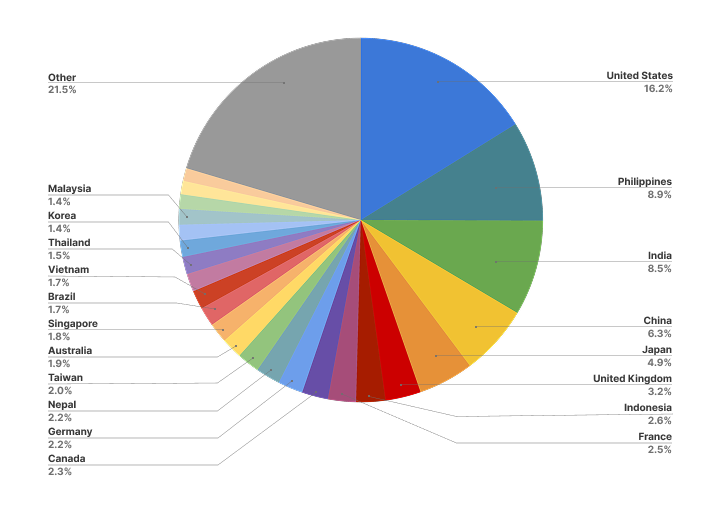
The majority of students enroll for business purposes (technical/humanities/international visas, highly specialized professional visas, intra-company transfers, diplomats, education, etc.). Many students also enroll while residing in regional areas or participate online from overseas. We also offer a curriculum aimed at obtaining Specific Skills Type 2 certification.

Nationality
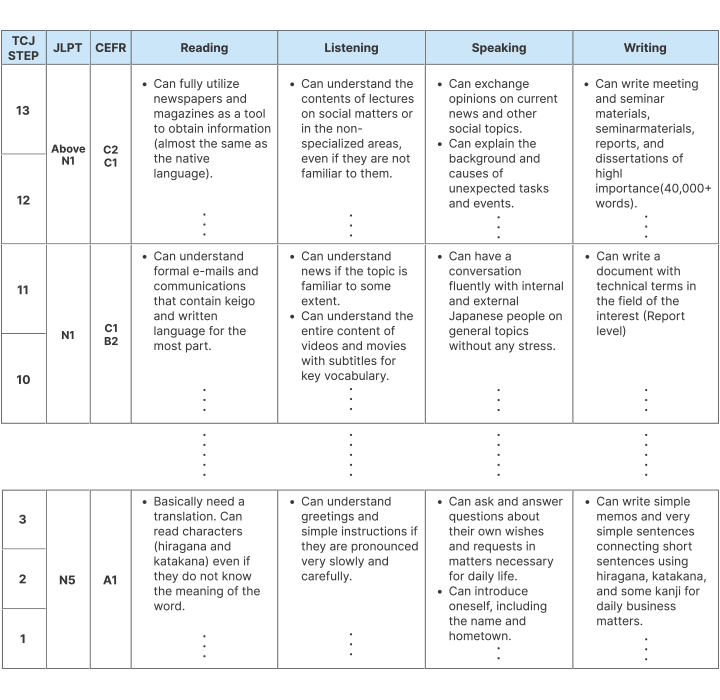
Curriculum designed to enhance all four Japanese language skills
Appropriate and regular assessments are essential for verifying learning progress. At TCJ, we have independently developed a Can Do list for the four skills of "reading," "listening," "speaking," and "writing," referencing the Japanese Language Proficiency Test (JLPT) and CEFR (JF Standard) levels.
Alongside regular academic assessments, students engage in mutual evaluation with instructors using Can Do lists. This approach helps them objectively gauge their current proficiency level, focusing primarily on the "speaking ability" most crucial in business settings. Additionally, instructors provide personalized learning advice to each student through feedback during regular consultations.
Available times and days / Lesson type / Learning style / Japanese level options
Time/Day
- Weekday AM
- Weekday PM
- Weekday Evening to Night (for Specific Skills)
- Weekday Night
- Weekend (Private Lessons Only)
Lesson Type
- In-person
- Online
- Instructor Dispatch (In-house Training)
*You may change the attendance format depending on the day.
Learning Styles
- Class Lessons
- Small Group Lessons
- Private Lessons
Japanese Language Level
- Zero Beginner Class (Starting with Hiragana and Katakana)
- Beginner/High Beginner Class (N5-N4 Level)
- Intermediate Class (N3 Level)
- High Intermediate Class (N2 Level)
- Super Advanced Class (N1 Level)
※All lessons include complimentary video lessons that complement the course materials.

Examples of Corporate-Sponsored Training Participation
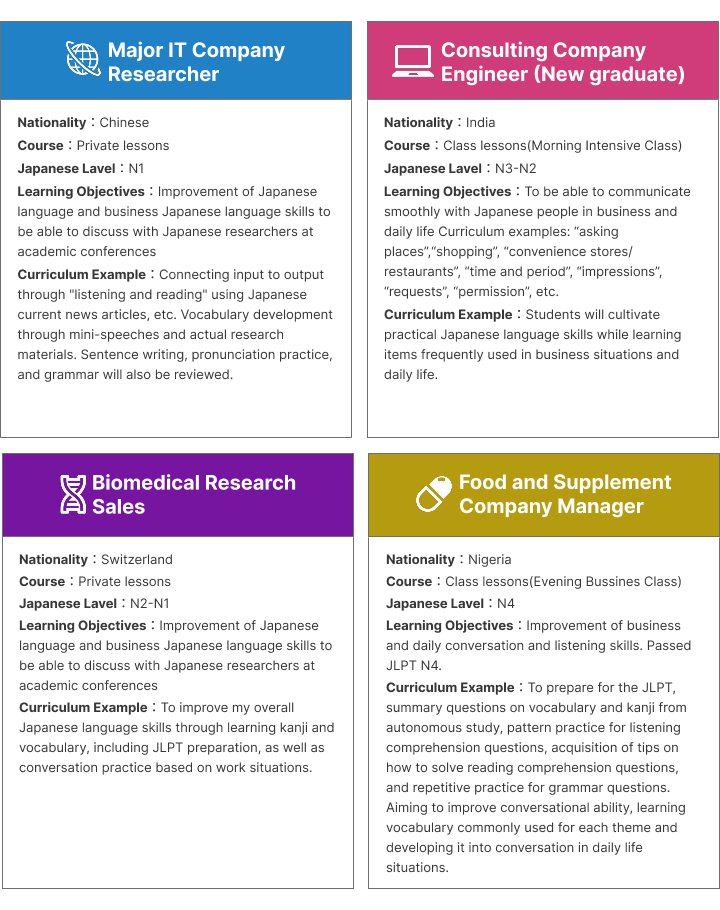
Feedback from corporate client
Here are testimonials from companies that have actually used TCJ's Japanese language education services.


Mr. Tatsuya Tobe
Nissui Con Corporation Singapore Branch
NISSUI CON is a comprehensive water infrastructure consultant that provides technical consulting services, including planning and design, with a focus on water supply and sewage projects. Since its establishment in 1959, the company has contributed to the realization of a sustainable society by providing diverse business solutions in the field of water infrastructure, including water supply and sewage systems, not only in Japan but also in more than 70 countries around the world.
NISSUI CON is promoting overseas business development in the water infrastructure field and is actively recruiting foreign employees.An international student who graduated from a Japanese graduate school will join an NISSUI CON group company, and we have decided to provide study support at a Japanese language school with a view to improving her Japanese language skills and making her a front-line player in our overseas business.
Q.
How did you decide to choose our school as a partner?
After gathering information on several Japanese language schools and meeting with a person in charge at the school, we decided that Tokyo Central Japanese Language School's study policy and curriculum were clear, and that the school's basic principles of proficiency in the four skills (speaking, listening, writing, and reading) were suitable for the students themselves. As a result, we decided to request Tokyo Central Japanese Language School to provide the service.
Q.
What are your impressions since you started taking courses at our school?
TCJ provides regular seminars for corporate staff, which are helpful because they give advice on the attitude of the company accepting foreign employees as well as that of Japanese employees.Also, the regular study reports help us to understand the level of proficiency of the students. It has been four months since she enrolled in the program, and due to her efforts, her Japanese language skills have clearly improved since the time she joined the company, and we hope she will continue her studies.
Q.
Please give a message to companies that are considering supporting Japanese language study for their foreign employees.
We receive a variety of support and advice on how to support Japanese language learning for foreign employees, including seminars for corporate staff, which we view as an opportunity for both the participants themselves and the hosting staff to be stimulated, and for the company to grow as well.We hope that the participants will be able to become future leaders in the company by learning the four skills of Japanese language, not only specialized skills, but also the company's business policy and culture.
Voices from Students

I am a fifth-year medical student, currently doing clinical rotations at a hospital where I can communicate in Japanese.
At TCJ, I learned a lot by practicing speaking with my classmates. During Zoom breaks, we had many interesting discussions about Japanese culture, current news, and life in Japan as foreigners. The teachers are really kind and passionate about teaching, and they provided slides not only to explain lessons but also to review what we had learned.
Japanese may be a difficult language, but participating in TCJ has taught me the joy of learning together with friends!

I'm a teacher and researcher in economics. During the 6 months of studying at TCJ, I can understand more and improve grammar. Particularly, applying how to use grammar in various situations in daily life. In addition, my speaking skills have also improved through interacting with teachers and friends, and by giving presentations. I also started to enjoy reading more because the topics in the textbooks are interesting and make me curious to learn more about Japanese culture.
Learning Japanese at TCJ is enjoyable. By talking with teachers, friends, and staff, I can find both fun and motivation to study.

As a tax accountant, I advise companies on mergers and acquisitions (M&A). I came to Japan in 2013 as an expatriate, and now, a few years later, I am in charge of payroll at a Japanese company.
TCJ has the most flexible class hours, especially in the evenings (7:00-9:00 PM), which is perfect for a working person like me. Also, the management team is very understanding of each student's priorities and needs. Most importantly, the "student's normal work" is given top priority. Each student is treated with respect and given individual attention. The location is also very convenient (only 30 seconds from Shinanomachi station on the Chuo-Sobu Line).
Lesson List
| Internal training | Class Lesson | Private Lesson | |
|---|---|---|---|
| Lesson Type | Choose from online, on-site, or instructor dispatch options. We deliver customized lessons tailored to your company's needs. | Choose between online or on-campus learning. Enroll in an existing class and participate in the lessons. | Choose between online or on-campus learning. One-on-one tutoring. |
| Schedule | Can be adjusted to your availability. | Choose from a wide range of schedules. | Can be adjusted with maximum flexibility. |
| Japanese Level | Tailored to participants. | Choose your class from Zero Beginner, High Beginner, Intermediate, High Intermediate, or Advanced Level. | Instructors provide customized programs tailored to each student's level. |
| Cost | Tuition Fee + Customization Proposal Fee | Enrollment Fee + Tuition Fee | Enrollment Fee + Tuition Fee based on contracted hours |
| Teaching Methodology | Direct Method (Teaching Japanese in Japanese) | Direct method or indirect method | |
Selectable Lesson Plans (Example)

Class Lesson
- Schedule
- 3 to 5 times per week
- Course Duration
- 8 months
- Japanese Language Level
- Zero Beginner~ Advanced (N1 and above)

Class Lesson+
A private lesson once a month is included at a special rate.
- Schedule
- 3 to 5 times per week
- Course Duration
- 8 months
- Japanese Language Level
- Zero Beginner~ Advanced (N1 and above)

Private Lessons
- Total Contact Hours
- 36 hours
- Target duration
- 3 to 6 months
- Japanese Language Level
- Zero Beginner~Special Grade (N1 and above)
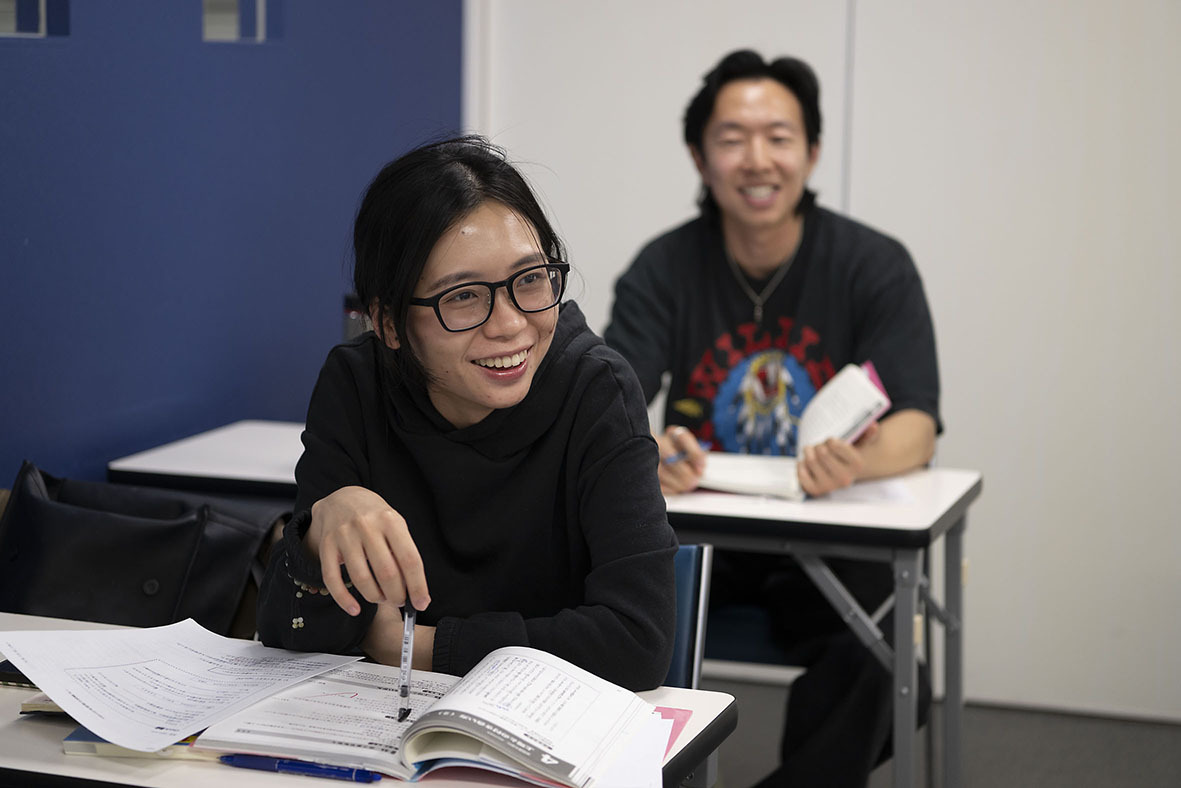
Saturday JLPT N2 Prep Class Lessons
- Schedule
- 1 day per Week
- Course Duration
- 8 months
- Japanese Language Level
- Intermediate (N3)~
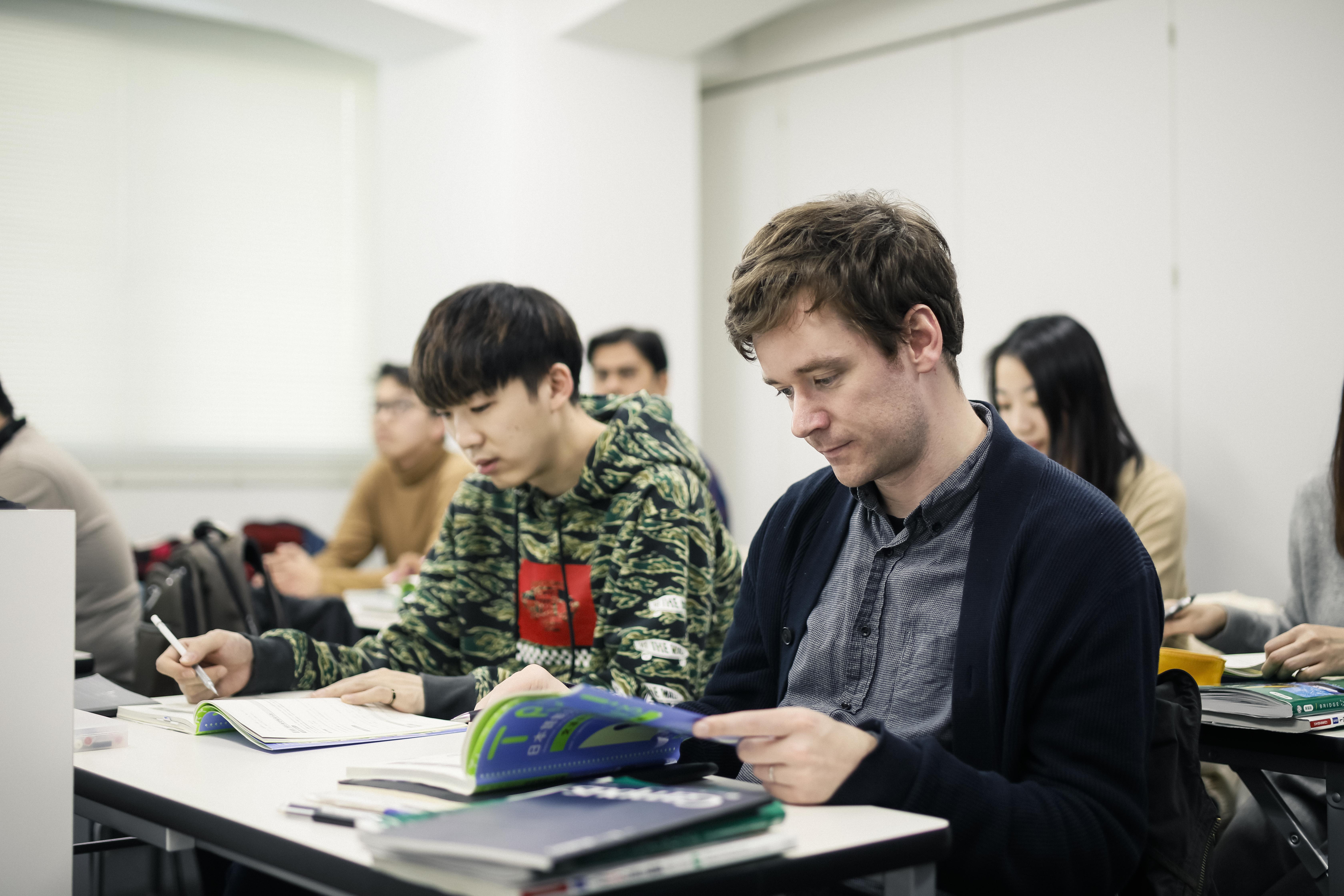
Customized Training
Optimal solutions and plans can be offered based on your company's needs, such as in-house training, instructor dispatch, and teacher training programs

Class Lessons (Specific Skills Course)
- Schedule
- 2 times per week
- Course Duration
- 12 to 18 months
- Japanese Language Level
- Zero Beginner~ Intermediate (N3)
Features: Japanese lessons tailored to specific industries are included.
Peace of Mind Follow-Up Service
The learning progress of foreign personnel will be shared regularly with your designated representative.
Monthly reports on lesson attendance status to corporate representatives
Sharing the assessment results every three months

We support your team's Japanese training.

What makes a workplace where foreign staff can succeed?
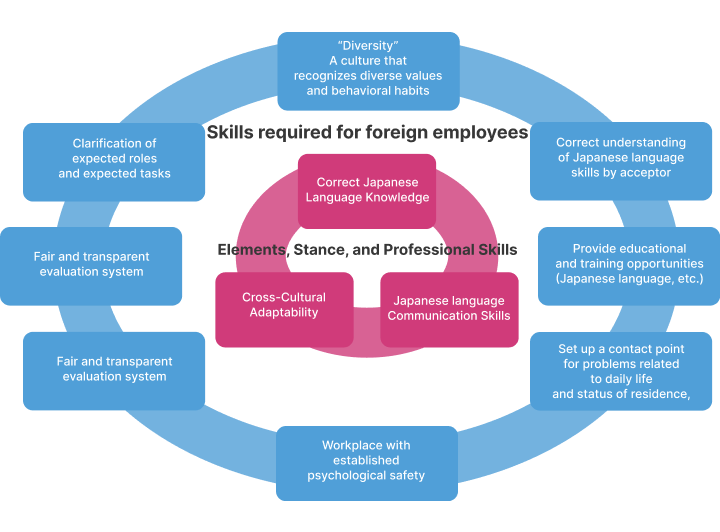
In the "Survey on Foreign Human Resources Working in Japan (2018)" conducted by JAPAN ASSOCIATION FOR PROMOTION OF INTERNATIONALIZATION(JAPI), it was found that the average length of service in Japan for foreign employees is only two years.
In many cases, the reason for this is not so much about themselves, but rather the lack of support and systems in the workplace that accepts them. In workplaces where foreign employees are established, (1) there is a culture and system in place that proactively supports foreign employees. In addition, the foreign employees who have established and are active in the workplace have (2) Japanese language knowledge, communication skills, and the skills to behave appropriately in a different culture.
Process for Admission
-
Identifying corporate needs and making proposals
-
Student counseling sessions
-
Level checks and class observations
-
Assigning classes and teachers
-
Tuition payments
-
Classes begin
Leave your concerns about foreign talent to our professional counselors. We'll propose Japanese lessons tailored for you.
Comparison with other lessons
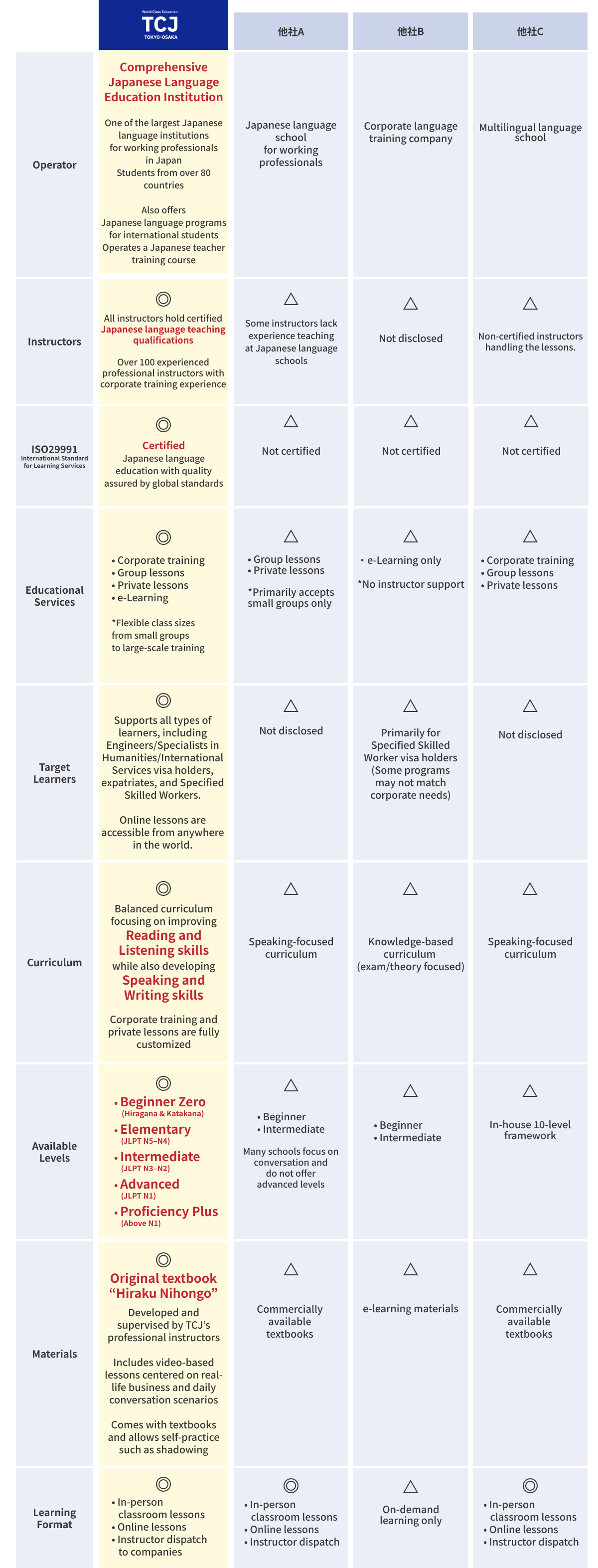
TCJ's Educational Method for Promoting Early Japanese Language Acquisition
TCJ's educational programs feature a unique system designed to help students quickly advance their skills.
Output and Collaborative Learning
Our lessons consistently aim for output-focused learning, with students speaking at least 70% of the time. Encouraging abundant output enables students to quickly acquire practical Japanese skills. We also promote collaborative learning to foster synergy among students. This involves encouraging classmates to ask each other questions and explain concepts to one another.

Comprehensive learning materials covering everything from preparation to review "Hiraku Nihongo"
TCJ has developed its own textbook, "Hiraku Nihongo," for use in lessons. This original Japanese language textbook breaks down learning content into small units based on specific Japanese "functions." It aims for efficient learning by ensuring students master each grammar point and sentence pattern one by one. Video and audio materials are also accessible via smartphones and tablets. "Hiraku Nihongo" is also widely used by Japanese language education institutions overseas.

Features of the "Hiraku Nihongo" Video (e-Learning)
Conversation Scene Learning Materials
You can practice on your own (shadowing), and it's also effective for improving your conversational skills.
Learn during spare moments
Videos linked to the digital textbook can be viewed on smartphones and tablets. Each unit takes 5-10 minutes, making it perfect for learning in spare moments. Access is unlimited during your TCJ course enrollment.
A wide range of levels available
From Hiragana and Katakana to JLPT N5, N4, and N3 levels.
Teacher-led accompaniment support
Teachers draw out students' motivation and provide coaching-style support to help them achieve their learning goals. At TCJ, we offer ongoing, supportive guidance to help students persist in their studies and reach their goals.
Teacher Profiles
Professional teachers with a wealth of experience

While a university student, he was involved in Japanese language education at a vocational high school in Taipei, Taiwan. Later, he was engaged in Japanese language education for international students at Japanese language schools and vocational schools in Japan, and during this process, he established a Japanese language school in Hanoi, Vietnam, and was stationed there. Currently, he is working at TCJ as a school principal and manager of the teaching unit for international students.

After graduating from university, while working for a translation company, she became interested in Japanese language education and passed the Japanese Language Teaching Proficiency Test. She began her career as a Japanese language teacher at a university and graduate school in China. After returning to Japan, she entered graduate school and obtained a master's degree in Japanese language education in contact scene research, which analyzes language behavior between native and non-native speakers. While teaching at Japanese language schools and universities in Japan, she continues to conduct practical research to record and analyze educational practices, present at academic conferences, and write articles.

After graduating from university, she studied Japanese language education at a professional graduate program, and upon completion, taught Japanese at a university in Taiwan. Later, she also taught Japanese at a university in Mongolia. After returning to Japan, she joined TCJ Global (Tokyo Chuo Japanese Language Institute). Currently, she is in charge of the Graduate School Preparation Course and the Employment Course, and is also involved in the development of teaching materials. With her extensive experience in Japanese language education, she provides education that meets the needs of a diverse range of learners. She also focuses on developing effective learning methods and new teaching materials.

After graduating from university, she studied abroad in the U.K., where she learned about second language acquisition and obtained certification as a Japanese language teacher. She then worked for a company that provided support for study abroad, but switched to a Japanese language school for international students in order to become a Japanese language teacher. After joining TCJ Global with the aim of advancing her career, she was involved in Japanese language instruction and support for part-time teachers at ROC CS Teaching Affairs.
All of TCJ's teachers are certified Japanese language instructors, and we have over 500 experienced professional teachers.
FAQ
Q.
I am considering Japanese language training for our foreign employees. What kind of plan do you recommend?
There are two options: 1) Participate in TCJ's courses, or 2) Create an original training plan for your company. If you are considering Japanese language training for a small number of employees, we recommend to join TCJ's current courses (1), which offers classes by level for from 1,460 yen per hour. On the other hand, if you are interested in individual group training for a group of 5 or 10 people, we can propose a curriculum for your company. In either case, please feel free to contact us.
Q.
I would like my foreign employees to take high quality Japanese lessons, what should I look for in selecting a school?
There are two important factors to consider when choosing a school: (1) whether all teachers are qualified, and (2) whether the service operator manages the quality of the teachers appropriately. All TCJ's teachers are qualified and experienced professional Japanese language instructors. In addition, management members monitor all teachers' classes twice a year, and all students are asked to submit teacher evaluation questionnaires once every three months, and the results are fed back to the teachers.
Q.
I want our employees to take the JLPT. Do you offer test preparation class?
Yes, most our courses are designed with the curriculum to prepare students for the JLPT exam. We also have optional classes that focus on JLPT exam preparation.
Q.
Are the lesson times flexible?
When you join the TCJ courses, students will be asked to schedule their lessons according to the time each class is held. For businessperson, weekday evening courses and private lessons are popular. If you would like us to create an original training plan for your company, you can specify the days and times flexibly.
Q.
Is it possible to take a course even if the person never studied Japanese before?
Yes, TCJ offers a zero-level course for complete beginners. Many foreign businesspeople have started learning Japanese from the zero level.
Q.
What kind of preparation do student need to take an online lessons?
We recommend students to use a laptop or tablet to view the screen better.(The lessons can also be taken with a smartphone) We also ask that you take the class in a place with a good communication environment. The school will invite you to Google Classroom, where you will be able to communicate with your teachers and classmates.
Q.
What kind of materials will be used in the lessons?
It will vary depending on your level. In addition to commercially teaching materials, TCJ's original materials and teachers' own materials will be used, and they are arranged according to students' subjects.
Q.
Is it possible to check the profile of the teacher who will be in charge of the training?
Yes, we will provide the profile of the teacher as soon as the teacher is confirmed.
Q.
How long should I expect the course period to be?
It depends on the foreign employee's current level of Japanese and the target level of it, but TCJ recommends that students continue taking classes for a minimum of 6 months to a year (minimum of 80-200 hours) in order to achieve meaningful skill improvement.
Q.
If students miss a class, what kind of follow-up do you provide?
Class content, handouts, homework, etc. are communicated to students through Google Classroom, so even if the students miss the class, they can still catch up on the class content. It is also possible to catch up by watching the class videos.
Q.
I would like to improve my level from N5 to N2 in 6 months, is that possible?
Yes, it is possible. Generally, it takes about 800 hours to reach from N5 to N2 level, but TCJ can help you improve your Japanese skills at a faster pace than the normal.
Q.
What nationalities are represented in TCJ's courses?
We have students from over 80 countries around the world. Our students come from North America, Europe, Oceania, Asia, and Latin America, so you will be able to interact with many different nationalities as classmates.
Foreign Talent Recruitment Service
Professionals in Japanese language education and foreign talent provide one-stop support from recruitment to training of foreign personnel
Local workforce development
Practical Japanese Language Education
Education on Japanese Lifestyle Habits and Business Etiquette
Foreign talent recruitment
Introducing eligible skilled workers, business professionals, and new graduate international students
Specific Skills registration support
Providing registration support services based on extensive expertise in residence status management (Registration Support Agency Number: 24-009708)
Foreign employee training
Japanese Language Learning Materials
Japanese Lessons Tailored to Your Goals and Level
Various After-Work Training Programs


Access
TCJ Global Inc.

TOKYO Shinanomachi Renga Building Campus
2F, 35 Shinanomachi, Shinjuku-ku, Tokyo
160-0016
Tel: 03-3354-5051

Osaka Shinsaibashi Campus
13F, THE PEAK SHINSAIBASHI,
3-4-26 Minamisemba, Chuo-ku, Osaka-shi, Osaka,
542-0081
Tel: 03-3354-5051


