


Unique Features of Japanese Gestures: Similarities and Differences Across Cultures
For those considering studying in Japan, attending a language school, or seeking employment in the country, understanding Japan’s unique gestures is essential—not just the language itself. During time spent in Japan, it becomes apparent that these gestures reflect distinctive cultural norms. Hand and body movements can vary significantly depending on language and cultural background.
This article explores commonly used gestures among Japanese speakers and highlights how they differ across cultures. We hope this article will support your daily life in Japan.
The Subtle Nature of Japanese Gestures
Gestures are commonly used in Japan alongside spoken words during communication. However, Japanese gestures are generally more subtle and involve smaller movements compared to those in Western countries.
This is because Japanese culture tends to prioritize understanding others’ feelings from nuances in words and facial expressions, rather than relying on exaggerated hand and body movements. This also explains why the same meaning can be expressed with different gestures, which may sometimes lead to misunderstandings.
It is important for learners to be familiar with Japanese gestures in order to communicate more smoothly with native speakers. Additionally, gestures from your own culture may carry different meanings in Japan, so paying close attention is essential.
Examples of Common Japanese Gestures
In this section, we explain commonly used gestures in Japan and how they differ from those in Western countries and other cultures.
Self-Referential Gestures
Japan: The nose or face is commonly used to indicate oneself.
Other Cultures: The chest is typically used.
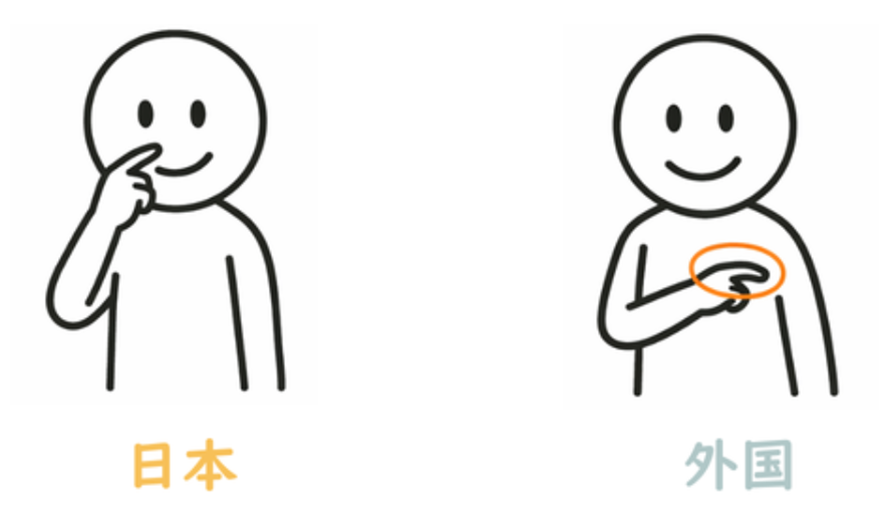
Japanese people often point to their nose with the index finger when referring to themselves. This gesture is unique to Japanese culture and may appear unusual to individuals from other countries. Some may wonder why the nose is used. In contrast, in many English-speaking countries, people commonly place their hand or thumb on the chest.
Beckoning gesture
Japan: The palm faces downward, and the fingers are curled inward.
Other Cultures: The palm faces upward, with the fingers moved toward oneself.
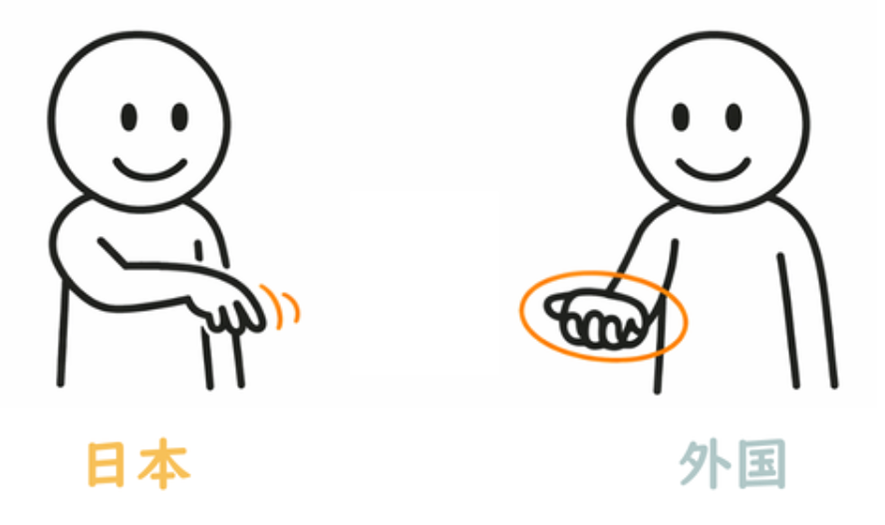
The Japanese gesture for beckoning someone differs from that in English-speaking cultures. The gesture with the palm facing downward may appear as if one is dismissing the person in Western contexts. Conversely, the Western-style gesture, with the palm facing upward, may be unfamiliar to Japanese individuals and can sometimes be perceived as slightly authoritative or commanding.
Gesture Representing Money
Japan: Form a circle with the thumb and index finger.
Other Cultures: Rub the thumb and index finger together.
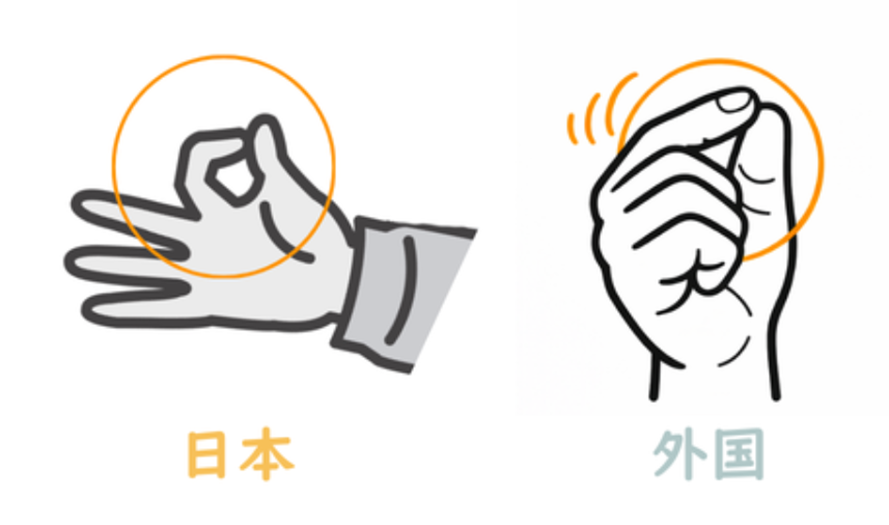
In Japan, people often form a circle with the thumb and index finger to refer to money. However, this gesture can signify “correct,” “good,” or “OK” in other cultures, which may lead to misunderstandings. In contrast, in many other countries, money is commonly indicated by rubbing the thumb and index finger together.
Gesture for “No” / “Incorrect”
Japan: Wave the arm side to side or cross the arms to form an “X.”
Other Cultures: Shake the index finger from side to side.
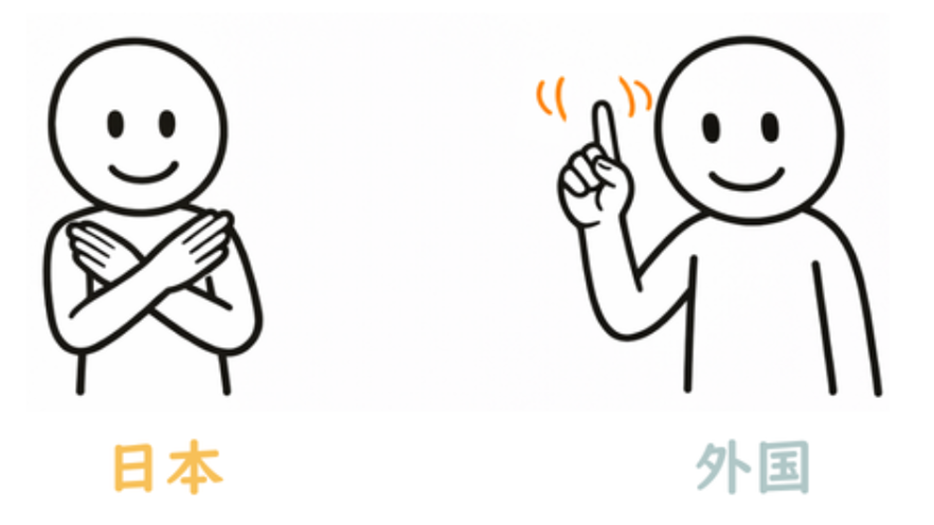
In Japan, people indicate negation by waving their hand side to side in front of the face or forming an “X” with their hands or fingers. However, this “X” gesture may appear too aggressive to individuals from other cultures, conveying a sense of rejection. In many English-speaking countries, a small side-to-side movement of the index finger is more common. Furthermore, this gesture is generally not used in business settings in Japan, so careful attention is required.
Gesture for “I Don’t Know”
Japan: Tilt the head and give a wry smile.
Other Cultures: Shrug the shoulders.
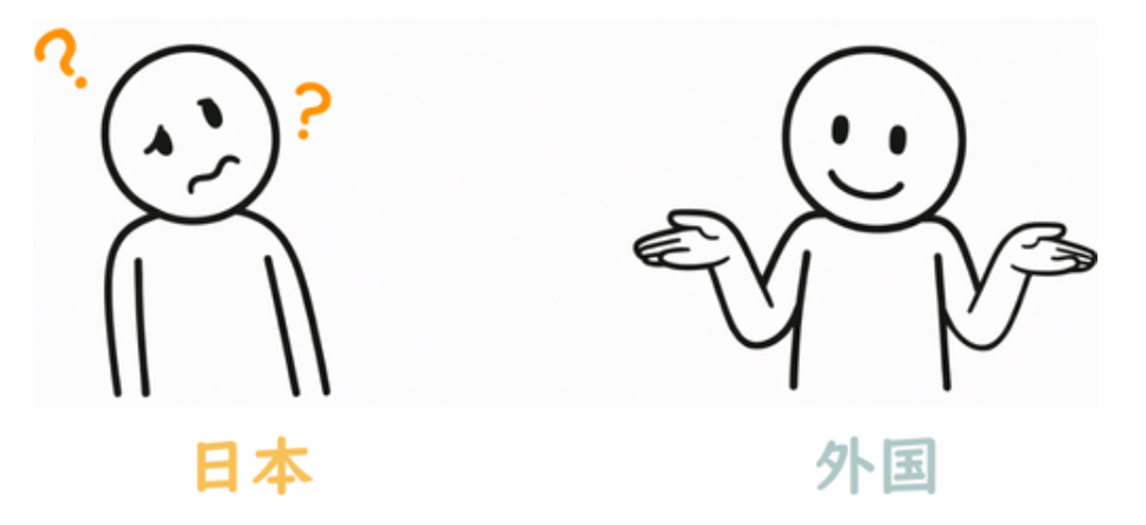
When unsure, Japanese people often tilt their head or give a wry smile. Some observers may assume they understood because of the smile, but in fact, they might just be masking their uncertainty. In contrast, in many other countries, a shrug of the shoulders is commonly used, whereas shoulder-shrugging is relatively rare among Japanese individuals.
Same Gestures, Different Meanings
The meaning of gestures can vary depending on culture or country. A gesture that is natural in your own culture may carry a different meaning in Japan.
For example, the gesture forming a circle with the thumb and index finger, introduced earlier, signifies “money,” “OK,” or “good” in Japan. However, in France, it can have a negative meaning, such as “zero” or “worthless.” In some countries, including Brazil, it may even carry a vulgar connotation, so caution is advised.
The iconic Japanese “peace sign” can also be confusing. In Japan, it is often used when taking photos. However, if the peace sign is shown with the palm facing toward oneself, it can carry an insulting meaning in countries such as the United Kingdom.
As illustrated above, the same gesture can carry different meanings depending on the country or cultural context. To avoid miscommunication, it is important to understand these differences and use gestures appropriately according to the people and environment involved.
Gestures to Be Mindful of in Japan
There are certain gestures that should be avoided or used with caution in particular situations when living in Japan or interacting with Japanese people professionally. Some of these gestures also require careful consideration in other cultural contexts.
First of all, pointing directly at someone is considered inappropriate in Japan. This gesture should be avoided, especially in business settings or formal occasions. When referring to someone, it is more appropriate to indicate direction using the whole hand with all five fingers together, or to explain verbally instead.
Second, loud voices and exaggerated gestures should be kept to a minimum in public. A quiet and calm atmosphere is generally preferred on trains, buses, and in restaurants. While this may vary by region, it is generally safest to keep one’s voice down on public transportation.
Lastly, caution is also required when it comes to touching someone’s head. In Japan, touching another person’s head may be considered impolite and should generally be avoided unless you have a close relationship with the person. Even when interacting with children, it is advisable to be mindful and ask their parents for permission beforehand. This point requires particular attention when engaging with Japanese children through school events or community activities.
Situations and Individuals Where Extra Care With Gestures Is Needed
In Japanese business settings or formal occasions, it is best to minimize gestures as much as possible. When speaking to superiors or someone you are meeting for the first time, a polite manner of speech and a restrained attitude are expected. Exaggerated gestures can give an overly casual impression or may be considered inappropriate.
In Japan, there are concepts such as “reading the air” (kuuki o yomu) and “being perceptive” (sasshi ga ii). These expressions reflect the high value placed on the ability to grasp non-verbal expectations, the atmosphere of a situation, and the intentions of others. This is often regarded as a distinctive aspect of Japanese communication, where understanding another person’s intent through subtle facial expressions and gestures—without relying heavily on words—is considered a virtue.
Sharing and discussing unique gestures in your country or region, as well as situations where they should be avoided, can be a great opportunity to better understand different cultural backgrounds.
Building Trust Through Gestures
In Japan, the idea that attitude and behavior are more important than words themselves is deeply rooted in the culture. The key to building smoother relationships is to practice appropriate communication tailored to each situation and individual.
Gestures can be a useful element of communication; however, their meanings and usage vary depending on cultural and social contexts. Exploring Japanese gestures and comparing them with those of other cultures can reveal interesting differences. Using appropriate gestures according to the situation and the individuals involved can help enrich communication.
Beyond the Japanese Language — Explore Its Gestures and Culture at TCJ
To master communication in Japanese, it is crucial to understand the culture, including gestures, daily habits, and traditions, alongside the language itself. At TCJ, priority is given to opportunities for sharing Japanese lifestyle, culture, and communication features in addition to language learning. In the classroom, learners can study Japanese in an immersive way while imagining real-life situations. By familiarizing themselves with natural expressions and behaviors unique to Japan—things that textbooks cannot fully cover—learners can acquire more practical and authentic Japanese. TCJ strongly supports each learner’s journey, helping them communicate confidently and live comfortably in Japan.
SHARE ON



- Japanese For Executives
- Japanese Manners
- Learn Japanese
- Japan Trivia
- Basic Japanese
- Japanese Culture
- Japanese Beginner
- Japanese Advanced
- Japanese Greetings
- Japanese Phrases
- Online Lesson
- JLPT
- Business & Daily Life Japanese Program
- ビジネス日本語
- Interview
- 日本語上級者
- Japanese tips
- Kanji
- Want to Learn Japanese
- Private Lesson
- Japanese for Expats
- International Student Visa Program
- Job Hunting in Japan
- Japanese Language School
- Email Phrases
- Business Japanese
- Keigo
4 Must-Have Apps for Everyday Life in Japan
Japan’s Iconic 抹茶(Matcha): Uncovering Myths and Reality