Top 100 Commonly Used Kanji in Japan – How Many Have You Encountered?

Today, we introduce kanji commonly used by Japanese people online and in books. It’s better to memorize kanji in context or through phrases in different situations rather than just trying to remember their readings and characters. The more you engage with kanji, the more familiar and approachable they will become!
Take a Guess at Which Kanji Are Commonly Used by Japanese People
What do you think are some of the kanji that are commonly used by Japanese people? Take a moment to think of a few.
In my prediction, kanji such as “日” (day), “円” (yen), “人” (person), “時” (time), and “月” (month) are likely to be among the most commonly used. Numbers like “一” (one), “二” (two), and “三” (three) are also frequently used. For verbs, “行” (go), “見” (see), “来” (come), and “話” (talk) are probably common, and for adjectives, “大” (big), “小” (small), “多” (many), and “高” (high) are likely to appear often. Additionally, kanji related to daily life, such as “国” (country), “生” (life), “米” (rice), and “水” (water), may also be widely used.
Top 100 Kanji Most Frequently Used Online
I found the perfect book, KANJI 2200: Listed According to Frequency and Familiarity to check the answers for the top 100 kanji commonly used online. As the title suggests, all the kanji are listed in order of frequency of use, making it a great way to learn commonly used kanji in Japan. It also serves as a dictionary. These rankings are based on frequency of appearance on the internet, though they may be outdated since the book was published in 2014.
Here are the top 100 kanji commonly used online:

Did you come across any kanji that you are familiar with, have seen before, or recognized? If there are any kanji that left you wondering, “How do I read this again?”, I recommend looking them up in a dictionary. Researching them yourself will help solidify your memory.
Discover a Variety of Kanji!
The method of learning kanji varies depending on the person, and it is crucial to find a style that suits you. Personally, I prefer to pick up kanji I see in texts and memorize them each time I encounter a new one, rather than practicing kanji using textbooks.
The reading of kanji differs depending on the words they are used in. Even if you memorize only the kanji or its reading, it might not be very practical or efficient. The kanji “日,” ranked 1st on the list of “Top 100 Kanji Commonly Used Online,” could be a good example.
“日”
On’yomi (Chinese-originated reading): nichi, jitsu
Kun’yomi (Japanese-made reading): hi, ka
Exception readings: 一日 (tsuitachi) – the first day of the month, 二日 (futsuka) – the second day, 昨日 (kinou) – yesterday, 今日 (kyou) – today, 明日 (asu, ashita) – tomorrow, 日本 (nihon, nippon) – Japan, and many more.
Here is my personal experience: when I learned English or Spanish, I didn’t adopt the method where you just use flashcards. For improving my English vocabulary, I preferred English textbooks with various thematic texts from which I could learn vocabulary, rather than ones that only list words with their meanings, accent marks, and examples. This method of learning engages you to pick up natural English words effectively, along with the scenes and contexts they’re used in. For studying Spanish, I gained more vocabulary through watching TV shows, taking notes, and writing down the scenes where new words were used, along with the context of their usage. This really helped me in daily conversations.
Some of the students I teach Japanese to are flashcard learners who prefer textbooks specialized in vocabulary or kanji. They check off the words or kanji they’ve memorized and go through them a few times. Seeing the textbooks worn out makes them satisfied in a certain way, realizing the progress and achievement, even developing a sense of attachment to their books. On the other hand, other learners go through five pages of the vocabulary book quickly in the morning and do the same at night, casually inputting words. By doing this, they say that when they see kanji in textbooks or around the city, they remember them, thinking, “This is the kanji I saw this morning!”
Here is a tip given by one of my students who, like myself, prefers learning kanji through context and situations. Coming from a country where kanji or Chinese-origin characters are not used, they initially avoided learning kanji due to a sense of difficulty. However, once they started, they found it more fascinating than it seemed and eventually became a kanji enthusiast.
“Kanji is something you ‘encounter,’ not just something to memorize or recall. Just like getting to know people, first, you meet them, interact a few times, and as you talk to them repeatedly, you gradually become familiar with them. The same process applies to kanji. When you first read a sentence, you will come across new kanji for the first time. As you encounter them repeatedly, you start to understand the contexts and situations in which they are used, what other kanji they commonly appear with, how they are read, and what nuances they carry.
For example, take the kanji ‘発.’ If you look it up in a dictionary, you will find two readings: hatsu and hotsu. However, simply memorizing these readings is almost pointless when, in words like 発表 (happyou, presentation/announcement), the tsu sound disappears. Understanding combinations such as 開発 (kaihatsu, development) and 発展 (hatten, growth/expansion), in addition to 発表, is crucial for grasping the nuances and imagery associated with the kanji. If you only learn ‘発’ in isolation, its meaning remains too abstract, making it an ineffective way to learn.”
That is an excellent and highly relatable comment. It is even more compelling than if I were to explain it myself. I encourage everyone to take it as a reference!
Top 100 Kanji Most Frequently Used in Books
The Agency for Cultural Affairs also conducts research on the frequency of kanji usage to understand how kanji is used in daily life. The study focuses on published materials, covering five categories: dictionaries, single-volume books, weekly magazines, monthly magazines, and textbooks. This research was published in 2022, making it relatively recent.
Here are the “Top 100 Kanji Most Frequently Used in Books”:
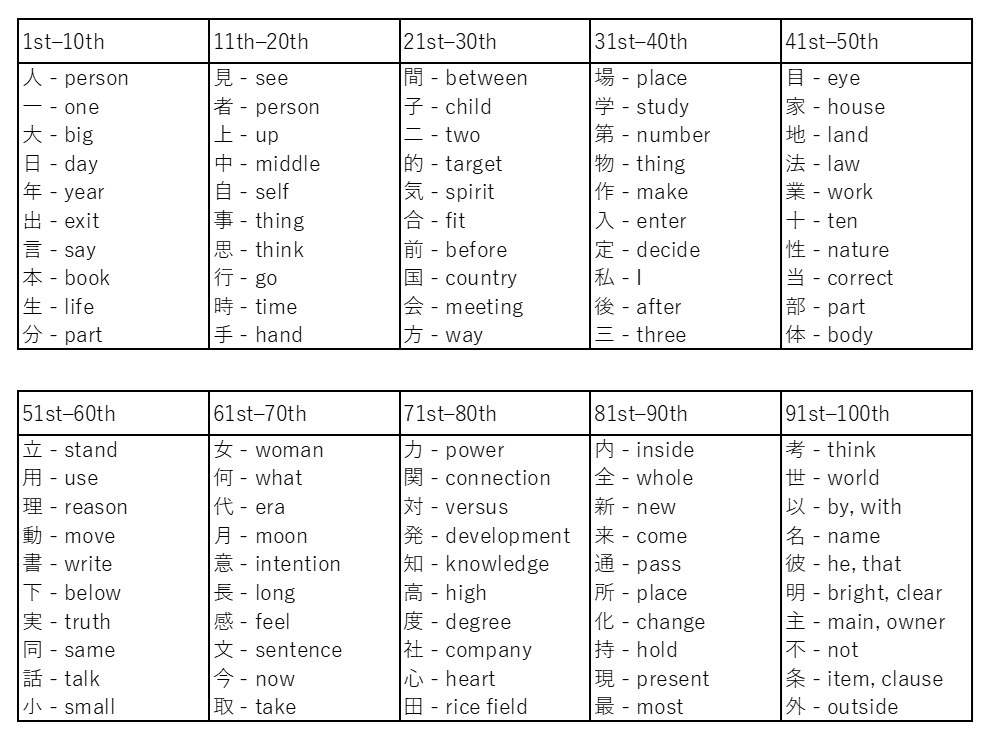
It is interesting that more intricate kanji appear in this list compared to the one shown earlier, “Top 100 Kanji Most Frequently Used Online.” Additionally, the kanji “何” (what) is ranked here but not in the previous list, which may be due to the fact that the word is typically written in hiragana online, such as “なに” (nani) or “なんで” (nande).
For the kanji “私” (I), which was ranked 91st earlier, it appears 38th in the list for online usage. This is likely because, online as in speech, Japanese people tend to omit the subject. Comparing kanji used in online contexts with those in books offers an interesting opportunity for speculation.
Mastering Commonly Used Kanji
Here are some kanji frequently used both online and in books:
Kanji for Numbers

Kanji for Time and Days of the Week

Kanji for Verbs (Selected 10 Due to Quantity)

Kanji Related to Quantities and Directions

Kanji for Nouns (Selected 10 Due to Quantity)

Let’s Learn More at TCJ!
Today, we explored kanji that are frequently used in Japan. While we weren’t able to cover their readings or usage in detail, learning kanji on your own is valuable. However, it’s always better to have someone like your teachers to guide you, as they can share interesting insights and the origins and history behind each kanji, making the learning journey much more enjoyable. Dive deeper into kanji at TCJ, where you’ll encounter a lot of kanji and truly get to know them!
References
Tokuhiro, Yasuyo. (2014).日本語学習のためのよく使う順 漢字2200 – KANJI2200 Listed according to Frequency and Familiarity. Sanseido.
Agency for Cultural Affairs, Language Division.漢字出現頻度数調査 (4)
“Kanji Frequency Survey (4).” Agency for Cultural Affairs,February 2022,
https://www.bunka.go.jp/seisaku/bunkashingikai/kokugo/kokugo/kokugo_82/pdf/93795801_14.pdf

SHARE ON


- Private Lesson
- Japanese for Expats
- International Student Visa Program
- Job Hunting in Japan
- Japanese Language School
- Email Phrases
- Business Japanese
- Keigo
- Japanese For Executives
- Japanese Manners
- Learn Japanese
- Japan Trivia
- Basic Japanese
- Japanese Culture
- Japanese Beginner
- Japanese Advanced
- Japanese Greetings
- Japanese Phrases
- Online Lesson
- Business & Daily Life Japanese Program
- Interview
- Japanese tips
- Kanji
- Want to Learn Japanese

Japanese Words Originating from Martial Arts

JLPT N4 Comprehensive Overview 2025: Difficulty, Content, and Effective Study Strategies