Useful Keigo words to use at work – Business Japanese

A brief overview of Japanese keigo
What is keigo?
Keigo is the honorific language used in Japanese to show respect towards others, particularly to those who are older or more distinguished. The character for kei (敬) means ‘respect’ or ‘reverence’ and the character for go (語) means ‘language.’ Keigo is an essential aspect of Japanese culture and has completely different grammar and vocabulary than informal Japanese.
Learning keigo is crucial for communicating effectively, building relationships and establishing trust. Using the appropriate level of keigo can also determine the social hierarchy and dynamics between speakers.
When to use keigo
Keigo is used in a variety of settings, for example in the workplace, or when speaking to more senior or distinguished people such as teachers, leaders, or officials. In Japanese companies, where hierarchy is important, speaking casually or informally to a superior or client can be seen as disrespectful. Thus, keigo is used in these situations to show regard for their position and expertise.
It is also used in everyday settings with people outside of your immediate family or circle. For example, when meeting someone for the first time, using keigo is a way of showing respect. In addition, it is commonly used in customer service situations, such as by wait staff, concierge, shop staff, etc.
We have an entire article about how to greet people according to various situations, so please read that for an in-depth look at greeting people in Japanese.

Practical points to remember about keigo
There are a few points that are useful to memorize when learning keigo. This is not a comprehensive list, but these are some of the most applicable ones.
1. Adding honorific prefixes
‘O’ and ‘go’ (御) are honorific prefixes, and are attached to the beginning of some words to add a sense of politeness and honor.
There are many examples of words that take the honorific prefix, but below are some of the ones you will see quite often in the workplace:
Words with the ‘go’ prefix:
- 確認 (kakunin; to confirm) → ご確認 (go kakunin)
- 協力 (kyouryoku; cooperation) → ご協力 (go-kyouryoku)
- 連絡 (renraku; to contact) → ご連絡 (go-renraku)
- 相談 (soudan; to consult) → ご相談 (go-soudan)
- 返信 (henshin; to reply) → ご返信 (go-henshin)
Words with the ‘o’ prefix:
- 忙しい (isogashii; busy)→ お忙しい (o-isogashii)
- 手数 (tesuu; bother) → お手数 (o-tesuu)
- 時間 (jikan; time) → お時間 (o-jikan)
- 手伝い (tesudai; help) →お手伝い(o-tetsudai)
One important thing to remember is that the prefixes should only be added when you are referring to someone else (second or third party) doing the action. It should not be applied when you are the one doing the action. This is because you are humbling yourself by adding an honorific prefix to something another party will do.
Let’s take 確認 (to confirm) as an example:
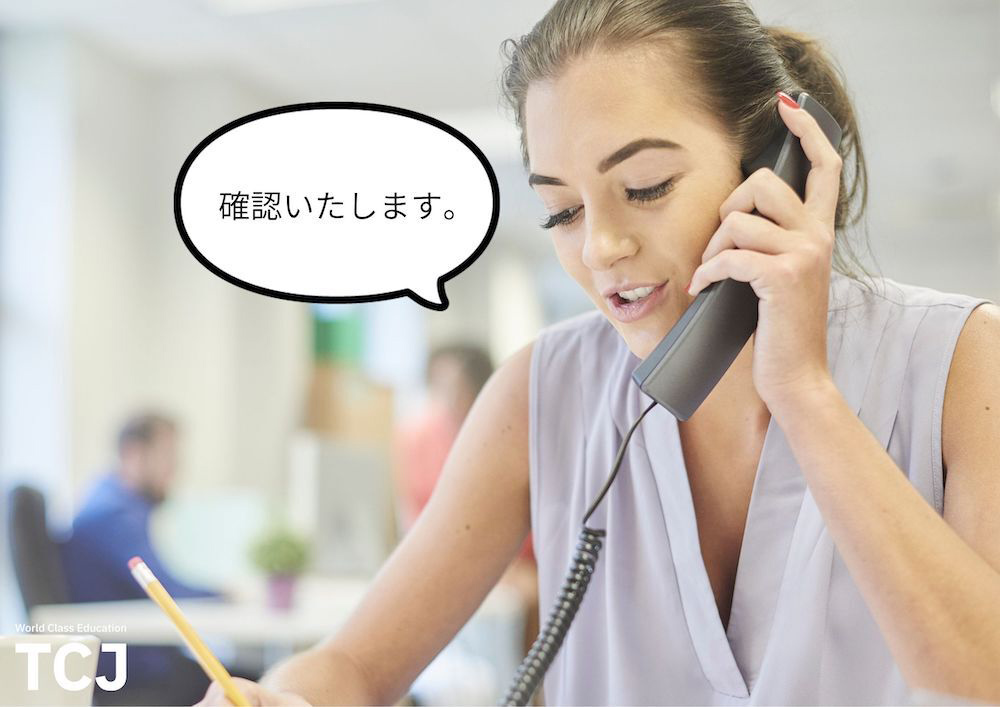
Incorrect: ご確認いたします (gokakunin itashimasu; I will check it)
Correct: 確認いたします ((kakunin itashimasu; I will check it)
If using ご確認, you would rephrase it this way:
Correct: ご確認ください (gokakunin kudasai; Please check it)
2. Shimasu (します) becomes itashimasu (致します)
Itashimasu is the polite form of shimasu (to do). Therefore, verbs that end in ‘shimasu’ become more polite if you use ‘itashimasu’ instead. Below are some common examples:
- 確認します (kakunin shimasu; to check) → 確認いたします (kakunin itashimasu)
- 失礼します(shitsurei shimasu; excuse me) → 失礼いたします (shitsurei itashimasu)
- 検討します(kentou shimasu; to consider) → 検討いたします (kentou itashimasu)
- 返信します (henshin shimasu; to reply) → 返信いたします (henshin itashimasu)
3. Using させていただきます (sasete itadakimasu)
The grammatical form させていただきます (sasete itadakimasu) comes up in business conversations quite often, but what does it mean, and how do you use it?
させる (saseru) means to let or to allow, while いただく (itadaku) means to receive something, so させていただきます (sasete itadakimasu) means that you are receiving the favor of someone allowing you do something. Essentially, it is a very polite way of saying that you will do something. In English, it’s similar to ‘allow me to do this’ or ‘please let me do this’.
Note that this only works when you are speaking about something that you (as the speaker) will do, not something that someone else will do. It’s also important to note that it only applies to some verbs and the usage depends on the context.
Below are some examples of how you can use it:
- 電話します
(Denwa shimasu; I will call)
↓
お電話させていただきます。
(Odenwa sasete itadakimasu; Please allow me to call)
- 話します
(Hanashi shimasu; I will speak)
↓
お話しさせていただきます。
(Ohanashi saseteitadakimasu; Please allow me to speak.)
- 回答します
(kaitou shimasu; I will answer)
↓
ご回答させていただきます。
(Gokaitou saseteitadakimasu; Please allow me to answer.)
Useful written Keigo words (and how to use them)
Below are some useful phrases and words that are used commonly in the workplace, particularly in business emails.

Master business Japanese with TCJ
If you are looking to master your business Japanese and keigo skills, TCJ offers classes and courses just for you. Consider the Business Japanese Class, where students learn key grammar and phrases, allowing them to master business Japanese in a short amount of time. The class, which is also available in-person or online, covers Japanese business etiquette, email writing, and other skills necessary for job hunting and working in Japan. TCJ also offers a job hunting course (please note that there are specific enrollment times for this course, so please inquire for further information) and private lessons.
The staff at TCJ are ready to help you achieve your career goals. Please get in touch if you’d like to learn more.

SHARE ON


- Basic Japanese
- Japanese Culture
- Japanese Beginner
- Japanese Advanced
- Japanese Greetings
- Japanese Phrases
- Online Lesson
- Business & Daily Life Japanese Program
- Interview
- Japanese tips
- Kanji
- Want to Learn Japanese
- Private Lesson
- Japanese for Expats
- International Student Visa Program
- Job Hunting in Japan
- Japanese Language School
- Email Phrases
- Business Japanese
- Keigo
- Japanese For Executives
- Japanese Manners
- Learn Japanese
- Japan Trivia

Japanese Words Originating from Martial Arts

JLPT N4 Comprehensive Overview 2025: Difficulty, Content, and Effective Study Strategies