
Express Your Feelings in Japanese
When receiving a gift or when someone congratulates you, expressing your feelings—such as saying, “I’m so glad” in addition to “Thank you”—can make your response even more heartfelt. Many people may find themselves wondering, “How can I express this in Japanese?” when trying to convey their emotions.
喜怒哀楽 – Kidoairaku
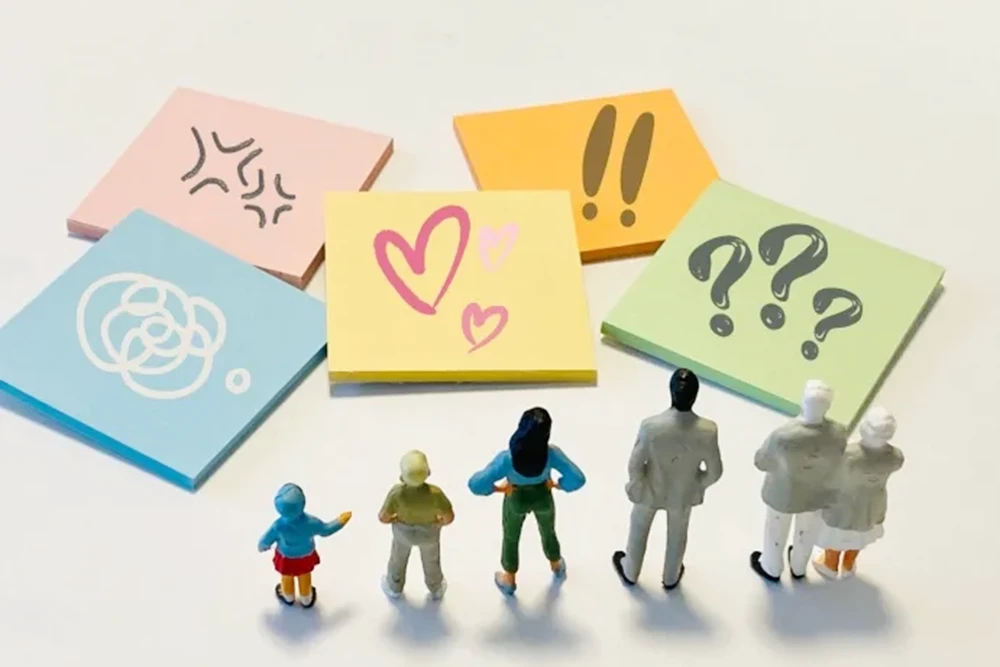
Today, we will explore various ways to express emotions through examples. In Japanese, there is a phrase “喜怒哀楽 (kidoairaku),” which refers to the four basic human emotions: 喜 (ki) for joy or happiness, 怒 (do) for anger, 哀 (ai) for sadness, and 楽 (raku) for pleasure or comfort.
Examples of “喜怒哀楽 (kidoairaku)” in use:
Aさんは喜怒哀楽が激しい。
(A-san wa kidoairaku ga hageshii.)
Person A has strong emotional reactions and openly expresses their feelings through facial expressions and behavior.
Bさんは喜怒哀楽が出ない。
(B-san wa kidoairaku ga denai.)
Person B does not show much emotion, making it difficult to tell how they feel from their expressions or behavior.
Expressions of Joy and Enjoyment
Here are some phrases to use when expressing feelings of happiness or enjoyment. We will also introduce the differences between 嬉しい (ureshii), 楽しい (tanoshii), and 面白い (omoshiroi), which are frequently asked about by learners.
嬉しい (Ureshii)
“Ureshii” refers to the feeling when things go as expected or when something good happens to you.
Examples:
家族に会えて嬉しい。(Kazoku ni aete ureshii.)
– I’m happy to see my family.
給料が上がって嬉しい。(Kyuryo ga agatte ureshii.)
– I’m happy that my salary has increased.
サッカーの試合で優勝して本当に嬉しい。(Sakka no shiai de yusho shite hontou ni ureshii.)
– I’m really happy that we won the soccer match.
楽しい (Tanoshii)
“Tanoshii” refers to the feeling of being satisfied with what you are doing at themoment and having a cheerful or pleasant state of mind.
Examples:
日本語のクラスはとても楽しいです。(Nihongo no kurasu wa totemo tanoshii desu.)
– My Japanese class is very fun.
昨日友達とカラオケに行った。楽しかった。(Kinou tomodachi to karaoke ni itta. Tanoshikatta.)
– I went to karaoke with my friends yesterday. It was fun.
面白い (Omoshiroi)
“Omoshiroi” refers to the feeling when you see something that makes you laugh or when you find something interesting and engaging.
Examples:
このアニメ、面白いから見てね。(Kono anime omoshiroi kara mitene.)
– This anime is interesting, so you should watch it.
Aさんの話はいつ聞いても面白いね。(A-san no hanashi wa itsu kiitemo omoshiroi ne.)
– Person A’s stories are always amusing to listen to.
Here are some other expressions related to “ureshii” and “tanoshii”:
楽しみです (Tanoshimi desu) / 楽しみにしています(Tanoshimi ni shiteimasu)
Example:
明日のパーティが楽しみです。(Ashita no pātī ga tanoshimi desu.)
– I’m looking forward to tomorrow’s party.
わくわくする (Wakuwaku suru)
“Wakuwaku suru” refers to the feeling of excitement and anticipation when looking forward to something enjoyable or awaiting a pleasant event with high expectations.
Example:
初めて日本へ行くのでわくわくしている。(Hajimete nihon e ikunode wakuwaku shiteiru.)
– I’m excited because I’m going to Japan for the first time.
幸せです (Shiawase desu)
“Shiawase” refers to the feeling of being extremely happy and deeply satisfied.
Example:
こんなにおいしい料理が食べられて幸せです。(Konnani oishii ryori ga taberarete shiawase desu.)
– I feel blessed to be able to eat such delicious food.
Expressing Negative Emotions: Sadness, Anxiety, and Anger
There are various ways to express negative feelings. First, let’s look at the differences between “kanashii” and “sabishii.”
悲しい (Kanashii)
“Kanashii” refers to a deep sense of sadness that may bring you to tears, often caused by something that has happened to you.
Examples:
大切な指輪をなくして悲しい。(Taisetsu na yubiwa wo nakushite kanashii.)
– I feel sad because I lost my precious ring.
恋人にさようならと言われて悲しい。(Koibito ni sayounara to iwarete kanashii.)
– I feel sad because my partner said goodbye to me.
寂しい (Sabishii)
“Sabishii” refers to the feeling of missing someone important or feeling lonely. It can also describe a quiet and empty atmosphere.
Examples:
家族に会えなくて寂しい。(Kazoku ni aenakute sabishii.)
– I feel lonely because I can’t see my family.
一人でご飯を食べるのは寂しい。(Hitori de gohan wo taberu nowa sabishii.)
– Eating alone feels lonely.
不安 (Fuan)
“Fuan” refers to a nervous feeling, a sense of unease when you think something unpleasant might happen, making it difficult to feel at ease.
Example:
今はいいが、5年後の生活は不安だ。(Ima wa iiga gonengo no seikatsu wa fuan da.)
– I’m fine for now, but I feel uneasy about my life five years from now.
心配 (Shinpai)
“Shinpai” refers to a restless feeling, worrying that something bad might happen.
Example:
もう10時なのに子どもが帰ってこないので心配です。(Mou ju ji nanoni kodomo ga kaette konai node shinpai desu.)
– My child hasn’t come home yet even though it’s already 10 o’clock, so I’m worried.
心細い (Kokorobosoi)
“Kokorobosoi” refers to the feeling of worry or insecurity when there is no one to help or rely on.
Example:
日本には友だちも家族もいないので心細い。(Nihon niwa tomodachi mo kazoku mo inai node kokorobosoi.)
– I feel insecure because I have neither friends nor family in Japan.
落ち込む (Ochikomu)
“Ochikomu” has a similar meaning to “kanashii,” but it carries nuances of being disappointed or feeling down. Here are some other phrases that describe negative feelings, particularly when you lack the motivation to do something or struggle to feel happy.
落ち込む (Ochikomu) – To feel down, depressed, or discouraged.
へこむ (Hekomu) – To feel deflated or disheartened.
気分がしずむ (Kibun ga shizumu) – To feel low or melancholic.
気がめいる (Kiga meiru) – To feel gloomy or mentally exhausted.
These phrases shown above share similar meanings—feeling down, lacking motivation, dwelling on negative thoughts, and finding it difficult to smile.
Example:
仕事で大きい失敗をして落ち込んでいる。(Shigoto de ookii shippai wo shite ochikondeiru.)
– I made a big mistake at work and feel down.
Next, here are expressions you can use when something you expected didn’t happen, things didn’t go as you wanted, and you feel disappointed:
残念です (Zannen desu) – That’s unfortunate. / What a shame.
がっかりする (Gakkari suru) – To feel disappointed / To be let down.
失望する (Shitsubou suru) – To be deeply disappointed. / To lose hope.
Examples:
雨で中止になって残念です。(Ame de chushi ni natte zannen desu.)
– It’s unfortunate that it was canceled due to the rain.
有名なレストランなのに料理がおいしくなくてがっかりした。(Yumei na resutoran nanoni ryori ga oishiku nakute gakkari shita.)
– I was disappointed that the food wasn’t good, even though it’s a famous restaurant.
腹が立つ (Hara ga tatsu)
Here are expressions for anger:
むかつく (Mukatsuku) – To feel annoyed, disgusted, or offended.
頭にくる (Atama ni kuru) – To get really mad, to feel enraged.
腹が立つ (Hara ga tatsu) – To be furious, to feel angry.
All of these phrases can describe “I’m upset.”
Examples:
Aさんはまたうそをついた。腹が立つ。(A-san wa mata uso wo tsuita. Hara ga tatsu.)
– Person A lied again, and that made me angry.
店員の態度が悪くて頭にきた。もうあの店にはいかない。(Tenin no taido ga warukute atamani kita. Mou ano mise niwa ikanai.)
– The store clerk’s attitude was bad, and it made me really mad. I’m never going to that store again.
イライラする (Ira ira suru)
“Ira ira suru” refers to the feeling of frustration when things don’t go as you want.
Example:
バスが来なくてイライラした。(Basu ga konakute ira ira shita.)
– I was frustrated because the bus didn’t arrive on time.
Expressions of Surprise
Lastly, we explore expressions for surprise. You can use these when something unexpected happens.
驚いた (Odoroita) – I was surprised.
びっくりした (Bikkuri shita) – I was shocked.
Some expressions of surprise also carry a meaning of praise.
すごい (Sugoi)
Example:
この料理、一人で作ったんですか。すごいですね。(Kono ryori hitori de tsukuttan desuka. Sugoi desune.)
– Did you make this dish all by yourself? That’s amazing!
すてき (Suteki)
Example:
とてもすてきな部屋ですね。(Totemo suteki na heya desune.)
– This room is lovely.
すばらしい (Subarashii)
Example:
すばらしい作品ですね。(Subarashii sakuhin desune.)
– This artwork is amazing.
Start Your Japanese Learning Journey with TCJ!
We received a comment saying, “A good thing about TCJ is that they offer a curriculum that is easy to continue.”
We offer various courses across multiple time slots, with finely divided levels ranging from beginner to advanced. Our highly-rated system allows you to choose between online and in-person classes flexibly.
For example, if work runs late, you can opt for an online class, or if the weather is nice, you can choose to walk to the school. Even students who usually take online lessons sometimes visit our in-person classes while on business trips or vacations from overseas. Moments like these are truly appreciated by our teachers.
The most important thing in learning Japanese is to keep going. At TCJ, we do our best to keep you motivated and engaged in your learning journey.
Let’s improve your Japanese together at TCJ! We look forward to seeing you.

SHARE ON



- Japanese Greetings
- Japanese Phrases
- Online Lesson
- JLPT
- Business & Daily Life Japanese Program
- ビジネス日本語
- Interview
- 日本語上級者
- Japanese tips
- Kanji
- Want to Learn Japanese
- Private Lesson
- Japanese for Expats
- International Student Visa Program
- Job Hunting in Japan
- Japanese Language School
- Email Phrases
- Business Japanese
- Keigo
- Japanese For Executives
- Japanese Manners
- Learn Japanese
- Japan Trivia
- Basic Japanese
- Japanese Culture
- Japanese Beginner
- Japanese Advanced
4 Must-Have Apps for Everyday Life in Japan
Japan’s Iconic 抹茶(Matcha): Uncovering Myths and Reality