

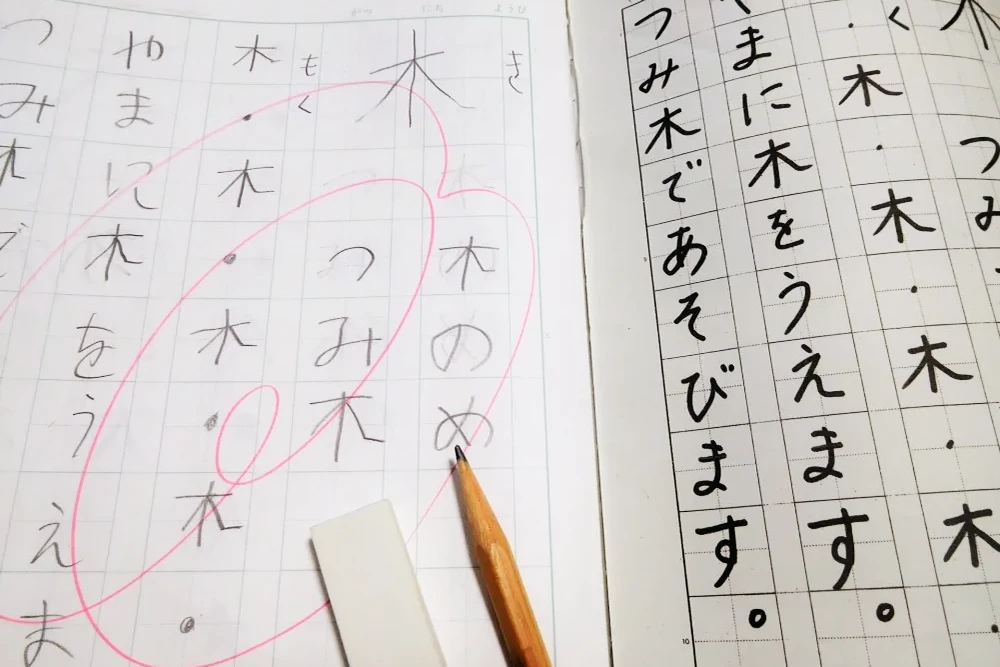
Let’s Learn Kanji (Chinese Characters) – Interesting Kanji – – Play with Kanji-
How to Memorize Kanji – Enjoy Memorizing Kanji –
Do you think that Kanji is interesting? Or do you feel “I cannot stand the sight of Kanji! I get a headache!” like this? The other day, at the corner of the Japanese language textbook of a bookstore, I saw the person who told a store staff “I have lived in Japan for 16 years and I wanna study Japanese language more. But I wanna know Japanese textbooks that do not use Kanji at all.” As I listened to this, I was impressed and thought, “She’s been studying Japanese for 16 years without using kanji. That’s rather amazing.”
Kanji is hard but it is interesting if you come to know it little by little. More Kanji you memorize, the more vocabulary you can use. And more Japanese phrases you can read. Moreover, even if you find words you do not know, you will be able to understand its meaning from the kanji used in that word.
First, I will introduce 3 tips to memorize Kanji. One is the order to study. You should memorize a Kanji in the order “how to read ⇀ meaning ⇀ how to write.” If you can read Kanji, you can read Japanese sentences. If you have a reading Japanese skill, you can look up definitions of words. Of course, it is the best that you can write Japanese. However, practicing reading Kanji is the first thing you should do.
The second thing is to memorize Kanji in words. One Japanese Kanji has many sounds to read. For example, “生” has 13 basic ways to read. Including words and place names, there are over 150 readings.
生きる: live, 生まれる: born, 生える: grow, 生じる: arise, 生ビール: draft beer, and 生活: life. All of them are read by each different sound. Remembering Kanji in example words is more interesting and easier than studying each reading of Kanji one by one. For example, “生ビール (NAMA biru) is a draft beer. 生 is NAMA of nama beer. I like NAMA beer~~~.” “My baby started 歯が生えた (HAeta): teething. So cute. I have to take his 歯が生えた (HAeta): teething shot.”
Third, you do not be disappointed if you forget. It goes without saying that letters of other languages are difficult. If I learn the language of another country, I forget it quickly. It is not a problem to forget new words. Next time you need the word, please look it up again. You can memorize frequently used kanji and words by looking them up many times.
Interesting Kanji – shape –
There are lots of interesting Kanji. This time, I will show you Kanji that are made up of many similar kanji.
“木”
One “木” 木 (ki): tree
Trees gather, 林 (hayashi): woods
More trees gather, 森 (mori): forest
“日”
“日” means 日 (hi): the sun
The light of the sun 昌 (sho)
The beautiful lights of the sun 晶 (sho)
I will introduce more Kanji using “日.”
There is a Kanji “旦 (tan)” that is similar shape with “日.” We have these words “元日 (ganjitsu)” and “元旦 (gantan).” “元日 (ganjitsu)” means January first and “元旦 (gantan)” means the morning of January first. “旦” expresses that the sun is rising from the ocean. “一” is the image of horizon and “日” is the sun. Can you imagine that “旦” means the sun risen from the ocean?
“一” sometimes expresses the ground or the sea. So, “一+↑” is “上 (ue): up” and “一+↓” is “下.”
Thus, we have other kanji that gather 3 same kanji such as “森” and “晶.”
If three “馬: horse” is gathers, it become “驫 (hyo).” It means that a horse runs fast. Gathering three “車: car,” it become “轟” that means loud noise of running cars. “品 (shina / hin)” is used in “商品 (shouhin): product” and “品物 (shinamono): good.” “品” is made with tree “口” means a container. “品” makes us imagine many things in containers.
Interesting Kanji – The Way to Memorize –
How do you think this words, “く (ku), ノ (no), 一 (ichi)?”
“く ノ 一” is “女: female (in this case, it definitely means a female ninja, kunoichi).” Writing “く ノ 一” in the order, you can finally write “女.” “く” is (ku) in Japanese hiragana, “ノ” is (no) in Japanese katakana and “一” is (ichi) in Japanese kanji. So, it means kunoichi (female ninja). We can see kunoichi in ninja movies or dramas. Other, there are lots of Kanji can be memorized by combining katakana and simple kanji, such as “く, ノ, 一.” It is interesting to focus on the katakana or simple Kanji parts inside a kanji character.
For example,
ハ + ム ⇒ 公(ko)
タ + ト ⇒ 外(soto)
タ + 口 ⇒ 名(na)
日 + 土 + 寸 ⇒ 時(toki)
ム + 月 + ヒ + ヒ ⇒ 能(nou)
立 + 兄 + 立つ + 兄 ⇒競(kyo・競うkiso-u)
田 + 月 ⇒胃(i)
木 + ツ + 女 ⇒ 桜(sakura)
八 + 十 + 八⇒ 米(kome)
We can find various parts of a Kanji. I recommend that you focus on the simple letter parts inside a Kanji with your friends or family like enjoying games.
Interesting Kanji – Play with Kanji –
In Japan, every December, “A Kanji of The Year” is announced at Kiyomizu temple in Kyoto. It is chosen that gets the most votes in Kanjis that people from all over Japan think is “this year’s Kanji” and apply for. We can apply online, and anyone can. It is broadcast on TV news that the monk of Kiyomizu temple writes the Kanji of the year on a large piece of paper. The Kanji of 2024 is “税 (zei).” “税” is tax. Even the monk was surprised. What kanji do you want to choose as “a kanji of the year?” What is your favorite kanji? If you write it and put it on the wall or set the image as the wallpaper of your phone, you can enjoy kanji.
Furthermore, making kanji of your name is interesting. For example, Ali is “亜里” or “愛理” and Cyrille is “希李流” or “帰里留.” You can get your own kanji name from kanji since the number of kanji is a lot. It is also good to think about it with your Japanese friends. If you can write your name in kanji, you may enjoy studying kanji.
Japan is said to be a fish country or a rainy country. If you like fish or fishing, you should know lots of kanji about fish. In Japan, there are over 200 kanji about fish. And there are about 35 kanji using “雨: rein” as a part inside a kanji. You can get interested in kanji if you start to study them from what you are interested in or related to your hobby.
From Teachers of TCJ
Many learners have this question, “how can we memorize kanji?” Each person has a different effective way to memorize kanji. Some people memorize them by reading them over and over again, while others do them by writing them down. Also, others do them by just staring at them. In my class, I try to have the students read out loud sentences that include kanji as much as possible. By reading aloud sentences containing kanji, you can learn how to read them and learn the meanings of kanji. Additionally, there are many vocabulary and kanji textbooks that allow you to study words and kanji using short sentences containing kanji. Kanji can be memorized through sentences, and kanji can be memorized through words. Please try.

SHARE ON



- Japanese for Expats
- International Student Visa Program
- Job Hunting in Japan
- Japanese Language School
- Email Phrases
- Business Japanese
- Keigo
- Japanese For Executives
- Japanese Manners
- Learn Japanese
- Japan Trivia
- Basic Japanese
- Japanese Culture
- Japanese Beginner
- Japanese Advanced
- Japanese Greetings
- Japanese Phrases
- Online Lesson
- JLPT
- Business & Daily Life Japanese Program
- ビジネス日本語
- Interview
- 日本語上級者
- Japanese tips
- Kanji
- Want to Learn Japanese
- Private Lesson

4 Must-Have Apps for Everyday Life in Japan
Japan’s Iconic 抹茶(Matcha): Uncovering Myths and Reality