


Are There Actually Three Types of Japanese Characters?
I was in charge of a Japanese class for JICA last month. This time, the participants barely understood any Japanese beyond simple words like “arigatou” and “sayounara.” It had been a while since I last taught a class using romaji (the Latin alphabet), so it was a bit challenging. However, I found it fascinating to teach Japanese to people with no prior knowledge of the language, and I made some new discoveries along the way.
One of the participants asked, “Why does Japanese have three types of characters?” and “How do you use them differently?” To answer, I gave them an example:
“1月20日にJICAのプロジェクトが始まりました。(The JICA project started on January 20.)”
This sentence includes all four writing systems used in Japanese: hiragana, katakana, kanji, and romaji.
Their reactions were quite candid. They were surprised that there were no spaces between words and questioned why commas were not commonly used. Some noticed how hiragana has many curves, whereas katakana looks more angular. Others pointed out how kanji contains so many strokes and appears intricate. Their fresh perspectives and honest impressions reminded me how unique and complex the Japanese writing system is.
Today, as we introduce the Japanese writing system, I reflect on these conversations with the participants, appreciating how their curiosity and insights brought new light to something so familiar to me.
The Origins and Evolution of the Japanese Writing System
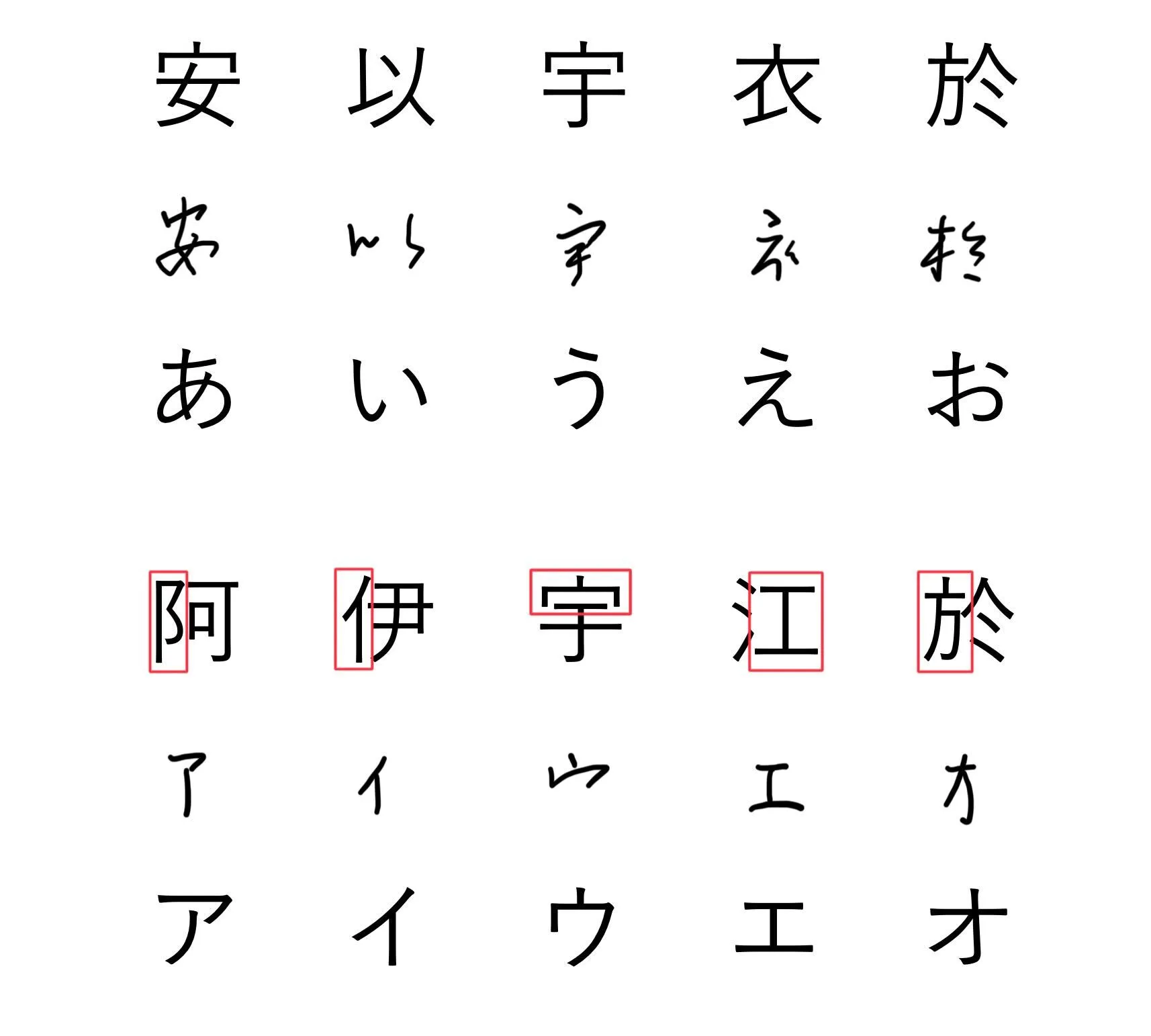
Kanji originated in China and were later introduced to Japan. While Japanese and Chinese share many of the same characters, some have different meanings or usages. Additionally, Japan has developed its own original kanji, known as “kokuji”, which were created domestically to represent uniquely Japanese concepts and names.
Both hiragana and katakana were derived from kanji, with their forms being reshaped over time. During the Heian period (794–1185), hiragana was created by simplifying and modifying the shapes of entire kanji characters, while katakana was developed by extracting parts of kanji. Personally, I didn’t even realize that katakana originated from kanji until I began teaching Japanese to a beginner class.
The term 仮名 (kana), as seen in hiragana and katakana, represents a “temporary name” because it was contrasted with the Chinese-origin kanji, which were referred to as 真名 (mana), meaning “true name.” It was historically believed that kanji were reserved for men, while kana were created for women who were not allowed to receive formal education. If that mindset had persisted until today, it would imply that only men would study kanji. Although this is purely hypothetical, it’s interesting to imagine how different the educational landscape might be.
An Overview of Hiragana
Q: How many characters are there in hiragana?
A: There are 46 basic characters in hiragana. Including 濁音 (voiced sounds) such as が (ga), さ (sa), だ (da), and ば (ba), as well as 半濁音 (semi-voiced sounds) like ぱ (pa), there are a total of 71 characters.
The biggest characteristic of hiragana is that, except for ん (n), all characters contain one of the vowel sounds: a, i, u, e, or o. If you try to extend the sound of each hiragana, you’ll notice that they all contain one of these vowels. This feature is also present in katakana.
Q: What is the charm of hiragana?
A: From my perspective, the charm of hiragana lies in its soft and gentle impression, giving a sense of familiarity and warmth due to its rounded shapes. For example, the words 幸せ and しあわせ (shiawase – happiness), 嬉しい and うれしい (ureshii – happy), 素晴らしい and すばらしい (subarashii – wonderful) have the same meaning and pronunciation, but the versions written entirely in hiragana, without kanji, convey a softer and warmer impression. Although this is just my perspective, I personally prefer not using kanji when writing these words on purpose. Another charm of hiragana is that “children can read it too.” Once you master hiragana, you can read books made for children on your own, as hiragana is the first script that Japanese children learn.
An Overview of Katakana
Q: When and for what purpose is katakana used?
A: Katakana is used to describe words that are imported from overseas, and are used as Japanese words, such as loanwords, names of places, people, and products in foreign countries. Here are some examples:
・パン (pan – bread)
・コーヒー (koohii – coffee)
・クリスマス (kurisumasu – Christmas)
・カフェ (kafe – cafe)
・アプリをインストールする (apuri wo insutooru suru – to install an app)
And more.
If you wish to learn more about loanwords, please refer to the article:
What Are Loanwords Used by Japanese People? Are They the Same as the Original Words in Terms of Pronunciation?
Q: How many characters are there in katakana?
A: The basics are 46 letters, the same as hiragana. However, katakana can describe some sounds that hiragana cannot. For example, the ヴァ sound in my name “パイヴァ” doesn’t exist in hiragana. When I got married in Japan and was registering my name in Japanese, I thought パイヴァ (paiva) was closer to the actual pronunciation of my name, which is Paiva, and looked cooler than パイバ (paiba). Since there is no “v” sound in the Japanese language, this pronunciation might not be familiar to Japanese people, which can be challenging when making reservations on the phone.
The ー (chōon) mark is a unique characteristic of katakana, used to indicate a prolonged sound, as seen in words like タクシー (takushii – taxi). In general, this mark is not used with hiragana. However, in informal situations such as texting with friends or posting on social media, it is sometimes used with hiragana. For example, おはよー (ohayoo – good morning) and ねむーい (nemuui – sleepy).
Q: What is the charm of katakana?
A: The appeal of katakana lies in its ability to convey a sense of coolness and style, particularly when used intentionally for loanwords. This imparts a lighter, more casual nuance to the words. For instance:
画像 (gazou – image) vs イメージ (imeeji – image)
芸術 (geijutsu – art) vs アート (aato – art)
By using katakana words instead of their native Japanese counterparts, it can broaden the meaning of each word, creating a lighter impression than the original.
Moreover, as exemplified by words such as:
綺麗, きれい, キレイ (kirei – beautiful)
お洒落, おしゃれ, オシャレ (oshare – fashionable, stylish)
The katakana form tends to project a greater sense of “coolness.
An Overview of Kanji
Q: How many kanji characters are there?
A: It is said that there are about 50,000 kanji characters in Japan.
Q: Are there two types of readings in kanji?
A: Yes, there are two types of readings: 音読み (on’yomi) and 訓読み (kun’yomi). For example, the kanji “水” has the on’yomi reading “sui” and the kun’yomi reading “mizu.”
On’yomi refers to the reading where Japanese people try to pronounce Chinese words in a Japanese accent, which is similar to how the English word “water” is pronounced in Japanese as “ウォーター” (wootaa).
On the other hand, kun’yomi refers to the reading that uses existing Japanese words and applies kanji characters to represent them. For instance, the word “mizu” already existed in Japan, and the pronunciation was assigned to the kanji for water, which is an example of a pictogram.
For kanji like “生,” there are several kun’yomi readings such as い-きる (ikiru – to live), う-まれる (umareru – to be born), and は-える (haeru – to grow). This suggests that different individuals assigned the kanji “生” to words like “いきる” (ikiru), “うまれる” (umareru), and so forth. It is indeed fascinating.
Q: How many kanji do Japanese people know?
A: Although there is no definitive data available, it is estimated that the average Japanese person is familiar with approximately 3,000 kanji. However, knowing a kanji and being able to write it are two different matters. Japan has a kanji proficiency test called the 漢字検定 (Kanji Kentei), which has a level requiring knowledge of up to 6,000 kanji. This advanced level is typically considered the domain of kanji enthusiasts, and achieving it requires familiarity with kanji found in classical literature or rarely used in daily life.
Q: How many kanji should foreigners know?
A: According to the guidelines set by Japan, students learn a total of 1,006 kanji throughout their elementary education. This means that if a foreigner knows these 1,006 kanji, they should be able to navigate daily life in Japan. However, it is important to note that each kanji has multiple readings, including both kun’yomi and on’yomi (some kanji have only kun’yomi). As a result, learners must memorize the readings, which effectively doubles the amount of memorization required compared to the number of kanji.
According to the old JLPT certification standards (which no longer disclose the number of kanji), Level 3 (now N4) required completion of a beginner Japanese course, with an estimated acquisition of around 300 kanji. Level 2 (now N2) required knowledge of approximately 1,000 kanji, while Level 1 (now N1) required about 900 hours of Japanese study and the acquisition of around 2,000 kanji.
Additionally, it’s important to note that learning kanji equivalent to those taught in Japanese elementary schools from the beginning may not always be the most effective approach for foreigners. The key is to focus on learning the kanji that are essential for communication and daily life first.
Q: What is the charm of kanji?
A: The most fascinating part of learning kanji is, without a doubt, the convenience. You can instantly grasp the meaning of a word simply by looking at the characters, and even if you’ve never seen the word before, you can often make an educated guess about its meaning. Additionally, for example, both いち and 一 mean “one,” but when writing kanji, it can be faster and simpler to write, as it is more compact and streamlined.
Let’s Learn More Japanese at TCJ!
Students who begin studying kanji often express their awareness with statements such as, “I had not previously noticed, but now I realize how many kanji are present in my surroundings, broadening my perspective,” or “It is gratifying to be able to read kanji in manga and anime.”
It is understandable that learning kanji can be challenging, but please know that you are not alone in this. Even native Japanese speakers face difficulties with kanji on a regular basis. The idea that “you know kanji because you’re Japanese” is not true. There are numerous kanji that cannot be mastered at once. Anyone studying kanji is part of the same journey. Let’s move forward together!
References
Koto, Y. (1997). 日本の文字のふしぎふしぎ
[The mysterious wonders of Japanese characters]. Arisukan.
Sekai no Moji Kenkyukai (Ed.). (2009). 世界の文字の図典
[Illustrated dictionary of the world’s scripts]. Yoshikawa Kobunkan.
Machida, K. (2004). 世界の文字と言葉入門1 世界の文字の起源と日本の文字
[Introduction to the world’s scripts and languages: The origin of world scripts and Japanese characters]. Komineshoten.
Machida, K. (2006). 世界のなかの日本語 2日本の文字の誕生
[Japanese in the world: The birth of Japanese characters]. Komineshoten.
Konno, S. (2017). 漢字とカタカナとひらがな 日本語表記の歴史
[Kanji, katakana, and hiragana: The history of Japanese writing]. Heibonsha.
JLPT Old Exam vs. New Exam Certification Criteria / Certification Guidelines
https://www.jlpt.jp/about/pdf/comparison01.pdf

SHARE ON



- Japanese tips
- Kanji
- Want to Learn Japanese
- Private Lesson
- Japanese for Expats
- International Student Visa Program
- Job Hunting in Japan
- Japanese Language School
- Email Phrases
- Business Japanese
- Keigo
- Japanese For Executives
- Japanese Manners
- Learn Japanese
- Japan Trivia
- Basic Japanese
- Japanese Culture
- Japanese Beginner
- Japanese Advanced
- Japanese Greetings
- Japanese Phrases
- Online Lesson
- JLPT
- Business & Daily Life Japanese Program
- ビジネス日本語
- Interview
- 日本語上級者
4 Must-Have Apps for Everyday Life in Japan
Japan’s Iconic 抹茶(Matcha): Uncovering Myths and Reality